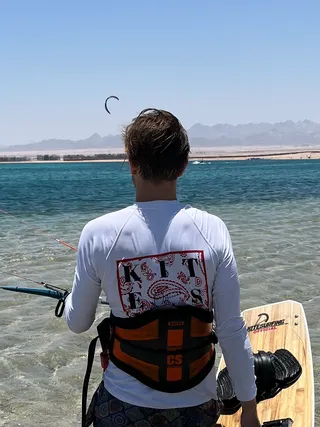
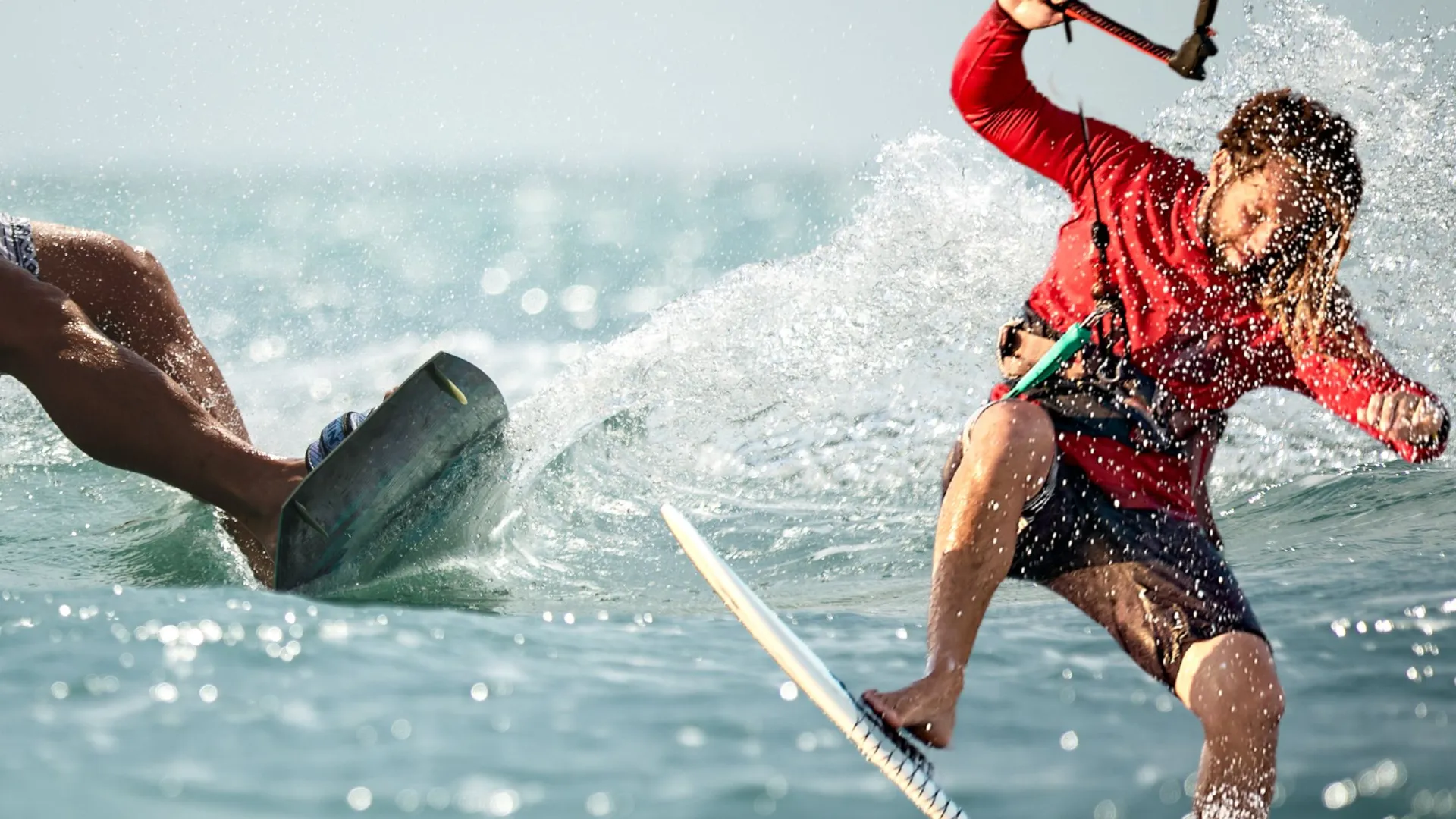
The twin-tip versus directional question sounds like a gear detail. It is closer to a fork in the road: the board you ride decides which version of kitesurfing you practice. Twin-tip riders build their sessions around the kite. Directional riders build them around the water. Both are proper kitesurfing, and the honest answer to "which is right for you" depends on what you want your sessions to feel like.
The short answer
Ride a twin-tip if you are learning, if you freeride, if you want to jump, or if you simply want the board that works at 80% of spots on 80% of days. Ride a directional if waves are the reason you kite, if strapless riding appeals to you, or if your home spot serves long light-wind days where glide beats pop.
Most kiters who stay in the sport end up owning both. The twin-tip almost always comes first.
What a twin-tip actually is
A twin-tip is symmetrical: both tips are identical, and the board rides the same in either direction. Change direction and you just shift your weight, the way a wakeboarder does. No footwork, no turning the board around.
That symmetry fits the mechanics of kitesurfing. The kite pulls in two directions along your tack, and a board that treats both directions equally lets you focus entirely on kite control. Edging against the kite, holding ground upwind, loading for a jump, landing with speed: the twin-tip is built for exactly the moves the kite asks of you. Lengths run roughly 130 to 160 cm, and the board directory covers every current model with uniform scores if you want to compare.
What a directional is
A directional is shaped like a surfboard because it descends from one: a nose, a tail, a set of fins, and one intended direction of travel. To change direction you either gybe the board or move your feet. Ridden with straps or strapless, its whole design chases one goal — working with moving water instead of muscling over it.
On a wave, a directional does what no twin-tip can: it draws lines. Bottom turn, top turn, trim high on the face, stall into the pocket. The kite becomes a tow rope and a safety net; the wave does the rest. Common sizes run from about 5'4" to 6'2" (165 to 190 cm), with volume choices depending on your weight and the wind range you ride.
The real differences on the water
| On the water | Twin-tip | Directional |
|---|---|---|
| Direction changes | Weight shift, instant | Gybe or foot change, a skill of its own |
| Upwind in chop | Efficient edge, predictable | Works, but demands more technique |
| Jumping | The jumping board — pop and boosting | Small jumps possible; strapless airs are their own discipline |
| Waves | Survives them | Made for them |
| Light wind | Bigger sizes help | Glide and volume shine here |
| Crashes | Forgiving | A loose surfboard in whitewater — less so |
Two of those rows decide most purchases. If jumping matters to you, the twin-tip wins outright: big air needs the locked-in stance and symmetrical pop that only a twin-tip delivers. If waves matter, the directional wins just as clearly.
Why beginners should start on a twin-tip
Learning to kite means learning two systems at once: the kite and the board. A twin-tip removes half of that load. Waterstarts work in both directions, direction changes cost nothing, and a missed landing usually ends with the board still on your feet.
Beginners who insist on starting with a directional take roughly two to three times longer to reach their first solid upwind riding. Every direction change becomes a technique lesson, every crash a board-retrieval swim. There is no medal for the harder path — the kiters ripping waves on directionals today almost all learned on twin-tips first. If you are at that stage, start with the beginners guide and use the kite size calculator before you buy anything.
When a directional makes sense
Three situations put a directional at the top of the list.
You kite for waves. Once riding upwind is automatic and your spot has swell, a directional turns kitesurfing into surfing with a wind engine. Down-the-line riding with the kite drifting on slack lines is a feeling a twin-tip cannot copy.
Strapless appeals to you. Strapless freestyle is its own craft: the board is held to your feet by wind pressure and technique, nothing else. It sharpens board feel like nothing else in the sport.
Your home spot is a light-wind spot. A directional's surface area and glide plane earlier than a comparable twin-tip. On 12-knot days a floaty directional keeps you riding while twin-tip riders sit on the beach doing forecasts.
Sizing, briefly
For a twin-tip, an average-weight rider lands between 133 and 143 cm, bigger for light wind and learning, smaller for strong wind and freestyle. For a directional, a 75 kg rider does well on a 5'8" to 5'10" as an all-rounder, taking 5'10" to 6'2" for light wind and 5'6" to 5'8" for serious wave riding. The boards buying guide walks through the trade-offs in detail.
Do you need different kites?
Your regular kites work fine with a directional. Serious wave riders eventually prefer wave-specific kites — the Duotone Neo, North Pulse or Cabrinha Drifter type — because they drift downwind on slack lines while you ride the face. That is a refinement, not a requirement. The board changes your riding first; the kite quiver can follow later.
The two-board answer
The question in the title has a quiet second answer: for many kiters it stops being either/or after a couple of seasons. A twin-tip for wind and jumps, a directional for swell and light wind — that pairing covers nearly every day the forecast can produce. Check what your home spot actually serves across the year, and let the water you ride most make the call.
If you are choosing your first board today: twin-tip. If you already ride upwind without thinking about it and the ocean keeps calling: the directional has been waiting for you.