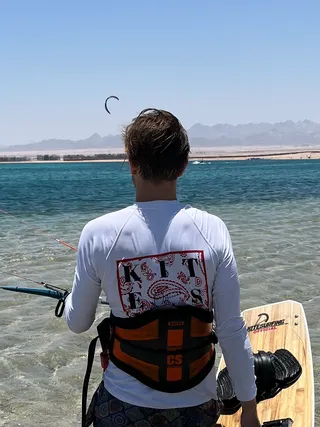
Kitesurfing runs on seven pieces of equipment: a kite, a bar with lines, a harness, a board, a wetsuit, a small safety kit and a pump. A complete new setup costs €2,000 to €4,000; a sensible used one €1,000 to €1,500. That is the whole shopping list. The rest of this guide explains what each piece does, which version belongs in a first setup, and the buying order that saves beginners real money.
If you are still deciding whether the sport is for you, start one step earlier with What is kitesurfing? — this guide assumes you are in.
The kite: one type wins for beginners
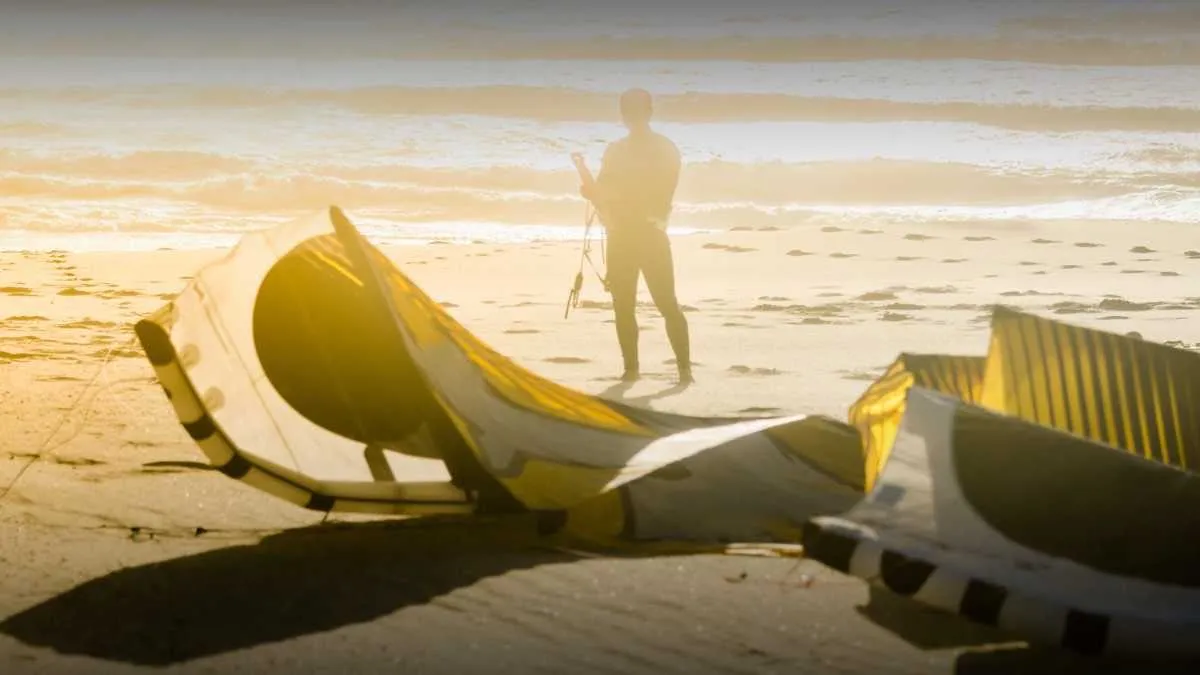
Walk any beach and nearly every kite you see is a tube kite (also called LEI, for leading edge inflatable): an inflated front tube keeps its shape, it relaunches from the water, and pushing the bar away sheds its power. This design has dominated the sport since the early 2000s for one reason — it forgives mistakes, and beginners make mistakes for a living.
The two other families exist for specific jobs. Foil kites hold their shape with air-filled cells instead of a pump, fly efficiently in very light wind and dominate racing and snowkiting; most cannot be relaunched from water easily, which is exactly the wrong trade for a learner. C-kites, the sport's original shape, survive as a niche tool for unhooked freestyle riders who want direct, aggressive steering. Both are worth knowing about. Neither belongs in a first quiver.
Size matters more than model. A kite is measured in square metres, and the right size follows your weight and the wind — our kite size calculator does the maths in ten seconds, and What size kite do I need? explains the logic behind it. When the time comes to pick an actual model, the best beginner kites compares the current candidates with uniform scores, and the full Kite Index holds every kite on the market.
The bar: your throttle, brake and eject seat
The bar looks like the simplest part and is the most safety-critical one. Sheeting it in powers the kite up; pushing it away depowers it; pulling the quick release above the chicken loop kills the power entirely and flags the kite onto one line. Lines are 20 to 24 metres of Dyneema, thin as spaghetti and strong enough to tow a car.
Two rules for beginners. First, learn the release until it is reflex — every school drills this, which is one more argument for proper lessons. Second, if you buy used, the bar is the one piece where age matters most: safety systems standardized and improved massively over the years, so an old bar with a worn release is a bad place to save €100.
The harness: where the power goes
The harness turns the kite's pull into something your hips carry, so your arms only steer. Schools start you in a seat harness, which sits low, cannot ride up and tolerates the high kite position every learner uses. Most riders then switch to a waist harness for their own setup: more freedom of movement, better fit with a lower kite, and the type nearly everyone rides long term.
Practical consequence: the harness is the first thing worth owning, even before the course is finished. It is the piece that must fit YOUR body, it costs relatively little, and a well-fitted one removes the most common beginner discomfort — a harness that rides up into the ribs.
The board: symmetrical first
Your first board is a twintip: symmetrical, fins at both ends, rides equally in both directions, no need to turn it around. Most beginners do well between roughly 135 and 145 centimetres depending on body weight, and slightly bigger is friendlier — more surface planes earlier and forgives light wind.
Directional boards (shaped like surfboards, for wave riding) and foil boards (a hydrofoil mast that lifts you silently above the water) are real disciplines to grow into, not starting points. We compared the twintip and directional worlds in detail in Twin tip vs. directional.
Wetsuit, safety kit, pump — the unglamorous rest
The wetsuit follows the water temperature, not the air: most of northern Europe means 5/4 mm for all but midsummer, warm-water destinations need only sun protection. It is also the second thing worth owning early, for fit and for hygiene.
The safety kit during the learning phase is a helmet and an impact vest (standard at every serious school, and worth keeping through your first solo season) plus the kite leash, which is not optional at any level. The pump is a pump; buy one with a pressure gauge and forget about it.
What a first setup costs, and the order to buy it in
The money mistake beginners make is buying everything before the course. The sequence that works: course first (€300 to €550, gear included; the fit and sizes you need only become clear on the water). Then harness and wetsuit, the personal-fit items. Then kite, bar and board, ideally after a conversation with your school about your local wind and your weight — or used, from a rider upgrading, which is where the €1,000 setups live. The complete cost picture including running costs is in How much does kitesurfing cost?
One kite or two? Start with one, chosen for the wind that actually blows at your home spot. A second kite widens your range later; a second kite bought on day one usually turns out to be the wrong size.
Where the gear takes you: the disciplines, in one tour
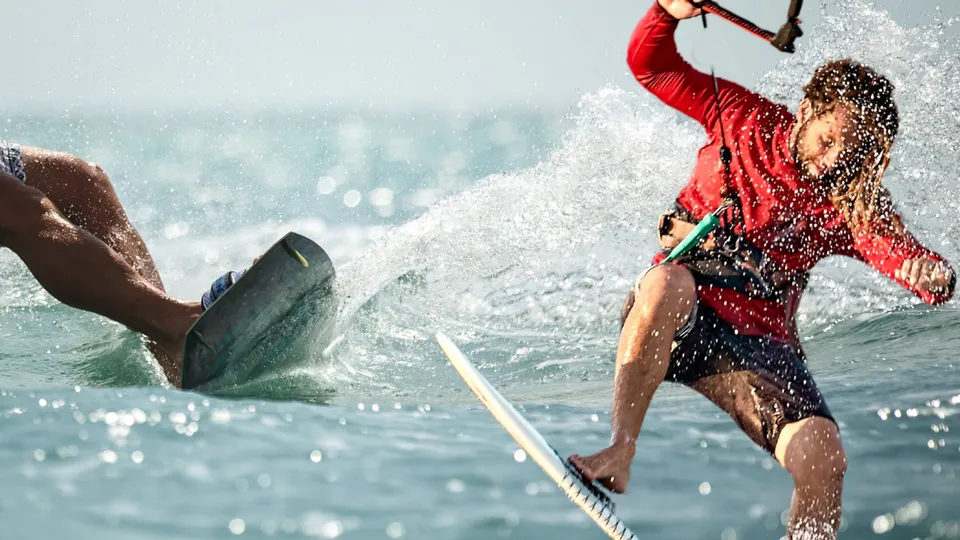
The same seven pieces open six different sports. Freeride is the default: cruising, carving, small jumps, most riders most days. Big air turns the kite into a 20-metre elevator and has become the sport's spectator discipline — our big air guide covers how it works. Wave riding swaps the twintip for a directional and uses the kite to catch swell. Freestyle means unhooked tricks on flat water; foil means flying silently above it in ten knots; racing means hydrofoil courses at olympic level. The disciplines overview maps them all. But every one of them starts on the same beginner twintip, behind the same tube kite.
Start here
Gear questions sort themselves out once the riding starts. Book the school, follow the beginner path through your first ten hours, and let your first setup be the one your instructor helps you choose — sized to your weight, your wind, your water. The gear list above will still be here when you are ready to buy.