Skip to content

6 chapters

Kitesurfing harnesses guide

The harness connects your body to the kite's pull. It's the piece of gear you wear for the whole session, and the right one changes how much control, comfort and energy you have on the water.

01 / 06

Your harness affects more than comfort

The harness takes the kite's pull through your hips and core instead of your arms. That's what lets you ride for hours instead of minutes. Its fit also affects your control, your breathing, your range of movement and how quickly you tire.

A harness that doesn't fit rides up onto your ribs, creates pressure points or twists out of position when you load the bar, and every one of those makes a session feel harder than it should. Fit and riding style matter more than stiffness, price or any other spec, and the same model can feel great on one rider and wrong on the next.

02 / 06

Main kitesurfing harness types explained

Waist harness

Wraps around the waist and lower back and sits above the hips. The most common type. It leaves the hips and legs free, so it suits jumping, rotations and most freeride and freestyle riding. It needs a good fit or it can ride up when the kite pulls up.

Best for

Freeride, freestyle, Big Air, most riders

Seat harness

Has leg loops and a lower hook point. It can't ride up the same way and holds you against an overhead kite, which is why many schools start beginners on one. Also chosen by riders who want lower-back relief or ride with the kite high.

Best for

Learning, lower-back support, kite-overhead riding

Both drawn from the front at the same scale. The dashed line marks where a waist harness puts the hook.

Hardshell waist harness

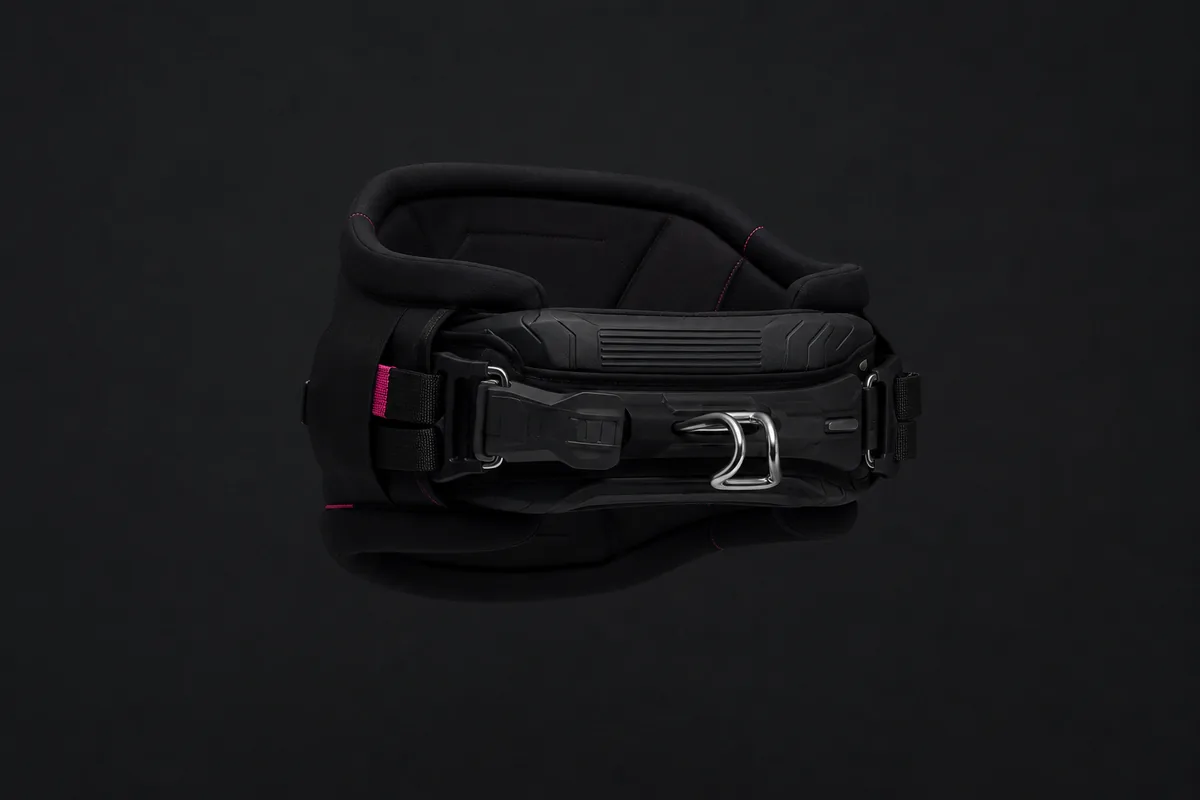
Uses a stiff back plate, often fiberglass or carbon, that keeps its shape under load and spreads the pull across a larger area of your back. It tends to stay put and resist ride-up, with a more direct, locked-in feel.

Best for

Powered freeride and Big Air, riders who want support

Softshell waist harness

Uses a flexible, padded shell that moulds to your body. Often lighter and more forgiving for travel and long sessions. Because it flexes, it can concentrate load more and move more than a hardshell if the fit isn't dialled in.

Best for

Comfort, travel, lighter sessions

Rope-slider setup

A spreader-bar option where the chicken loop runs on a rope and slides side to side. The harness stays put while the hook point follows your movement, which helps in waves and toeside riding. It makes loading for big jumps harder.

Best for

Wave and surf-style riding

Waist harness vs seat harness

  • Fit position

    Waist harness
    Waist and lower back, above the hips
    Seat harness
    Waist plus thighs, lower hook point
  • Freedom of movement

    Waist harness
    More free in the hips and legs
    Seat harness
    More restricted around the legs
  • Ride-up tendency

    Waist harness
    Can ride up if the fit is loose
    Seat harness
    Stays low, resists riding up
  • Back support feeling

    Waist harness
    Depends on the shell and fit
    Seat harness
    Holds the lower back, supportive
  • Kite overhead

    Waist harness
    Can get pulled up
    Seat harness
    Holds you down well
  • Wave / foil

    Waist harness
    Common once skills are solid
    Seat harness
    Used by some for kite-overhead and light wind
  • Big Air / freeride

    Waist harness
    The usual choice
    Seat harness
    Less common
  • Common downside

    Waist harness
    Ride-up with a poor fit
    Seat harness
    Less freedom, can feel bulky

Neither is automatically better. A waist harness gives more freedom; a seat harness gives a lower, more locked-down hold. Body shape, where your kite usually sits and how you ride decide more than the label.

03 / 06

Hardshell vs softshell

  • Load distribution

    Hardshell
    Spreads the pull over a larger area
    Softshell
    Can concentrate load more
  • Flexibility

    Hardshell
    Stiff, holds its shape
    Softshell
    Flexes and moulds to the body
  • Directness

    Hardshell
    More direct, locked-in feel
    Softshell
    Softer, more forgiving feel
  • Comfort

    Hardshell
    Supportive; depends on fit
    Softshell
    Often comfortable out of the box
  • Weight / travel

    Hardshell
    Usually a bit heavier
    Softshell
    Often lighter, easy to pack
  • Price tendency

    Hardshell
    Often higher
    Softshell
    Often lower to mid
  • Fit sensitivity

    Hardshell
    Rewards a precise fit
    Softshell
    More tolerant of fit

A stiffer shell isn't automatically the right call. Hardshells spread load and feel direct; softshells flex and forgive. The deciding factor is how the shape matches your back, so try it under load if you can.

Spreader bar, hook and rope slider explained

Standard / fixed hook

A hook fixed in the centre of the spreader bar. It gives a direct, solid connection, so you can lean against the kite and load up for jumps. It's the usual choice for freeride, Big Air and freestyle, and a fixed hook is needed if you want to unhook.

Rope slider

The chicken loop runs on a rope and slides left and right. The hook point follows you instead of the harness twisting, so the harness stays put and toeside and upwind body-dragging feel easier. Wave riders often prefer it; loading for big jumps is harder.

Spreader bar width & shape

The bar holds the harness together and spreads the load. A wider bar that isn't maxed out on the adjustment keeps the harness in place and stops it pointing up when the kite is overhead. Bar fit matters as much as the shell.

  • Spreader bars, hooks and quick-release parts are safety-critical. Use the parts your harness and bar are designed for, and follow the manufacturer's guidance. Don't mix incompatible systems or modify these parts yourself.

04 / 06

How a kitesurfing harness should fit

Fit is the single thing that decides whether a harness works for you. The same size from two brands can sit completely differently, so the size label is only a starting point.

  • Sits between the top of your hips and below your ribs, belt over the navel
  • Snug enough that it barely moves when you twist your torso
  • Doesn't ride up onto the ribcage when you load the bar
  • No sharp pressure points or pinching, and it doesn't restrict breathing
  • Spreader bar centred, not tilting up and not maxed out on either side
  • Works with the wetsuit or impact vest you'll actually wear
  • Hook and quick release are easy to reach and operate

Measure around your waist at the belly button, not your trouser size. Before you commit, try the harness under load, hooked into a kite or static line on the beach.

05 / 06

Beginner harness vs performance harness

  • Fit tolerance

    Beginner-friendly harness
    More forgiving
    Performance harness
    Rewards a precise fit
  • Comfort

    Beginner-friendly harness
    A priority
    Performance harness
    Balanced with support and feel
  • Support

    Beginner-friendly harness
    Secure, stable hold
    Performance harness
    Discipline-specific support
  • Movement

    Beginner-friendly harness
    Stability over maximum freedom
    Performance harness
    Tuned to the riding style
  • Price

    Beginner-friendly harness
    Lower to mid
    Performance harness
    Mid to high
  • Discipline focus

    Beginner-friendly harness
    General learning and freeride
    Performance harness
    Wave, foil, Big Air or freestyle
  • Who should buy it

    Beginner-friendly harness
    New and progressing riders
    Performance harness
    Riders with a clear style and goals

A beginner-friendly harness prioritises a secure, comfortable fit. A performance harness is tuned to a discipline. Most riders are well served by getting the fit right first and specialising later. A seat harness can help some beginners because it rides up less, and many riders move to a waist harness as they progress.

Which harness fits your riding style?

If you're learning

A comfortable, secure harness: a seat harness or a well-fitting waist harness. Prioritise fit and lessons over stiffness.

If you freeride

A waist harness with a fit that doesn't ride up. Hardshell and softshell both work, so pick the one that fits your back.

If you ride waves

A waist harness, often with a rope slider so the hook point follows your movement and the harness stays put.

If you foil

A harness that stays low and supportive with the kite often overhead. Some riders use a seat or a snug waist harness.

If you jump or ride Big Air

A supportive waist harness with a fixed hook so you can load up and lean against the kite.

If you ride freestyle or wakestyle

A waist harness with a fixed hook, since unhooked tricks need a fixed connection.

If you're unsure

A well-fitting waist harness covers most riding. Get the fit right first and refine later.

How harness choice affects control and fatigue

How a harness spreads the kite's pull changes how long a session feels. A shape that distributes load across your back lets you hold power longer; one that concentrates it, or that rides up and changes your posture, tires you out faster and pushes the bar out of position.

Riding powered exposes a poor fit quickly. The harness is one part of a setup that also includes your kite, board, bar and riding style. A comfortable harness makes good riding easier and can help you progress, but you still have to learn the technique.

06 / 06

New vs used harnesses

A used harness can be a sensible buy if it still fits you and the safety-critical parts are in good shape. Harnesses have no electronics, but they do wear: the webbing, stitching, buckles, spreader bar, hook or rope and the closure all take load every session.

Check everything that carries the kite's pull before you commit. The webbing should be free of fraying, the stitching intact, the buckles and closure smooth, and the spreader bar, hook or rope should not be heavily worn. A cracked shell, frayed webbing or a worn rope-slider setup is a reason to walk away or budget for replacement parts. Whatever the price, the harness still has to fit your back correctly.

Used harness checklist

  • Stitching intact, no pulled or broken seams
  • Webbing not frayed, cut or stiff with age
  • Buckles and closure open and lock smoothly
  • Spreader bar secure, not bent or cracked
  • Hook or rope slider not heavily worn
  • Back shell not cracked or delaminated
  • Padding still supportive, not crushed flat
  • No corrosion on metal parts
  • Correct size and good fit for your body

Harness brands you'll often see

Several established kite and watersports brands make harnesses, alongside specialists focused on harness design. You'll commonly see Mystic, ION, Ride Engine, Dakine, Manera, Prolimit and Ozone, among others. Hardshell and softshell options exist across the market, and different brands cut their harnesses for different body shapes.

Brand name alone won't tell you if a harness fits you. Two harnesses with the same size label can sit completely differently on your back. Try the fit, the spreader bar system and the size in person where you can, and treat the brand only as a starting point.

Common mistakes when buying a harness

Buying by the size label alone instead of trying the fit

Choosing a stiffer shell because it sounds better, without checking that it fits

Buying too large so it rides up under load

Ignoring ride-up instead of fixing the fit or spreader-bar height

Overlooking spreader bar width, shape and compatibility

Buying a rope-slider setup without knowing why you'd want it

Buying used without checking the webbing, stitching and spreader bar

Copying a pro's setup that's tuned for a different style and body

Forgetting the wetsuit or impact vest changes the fit

Not testing the harness under load before buying

FAQ

Kitesurfing harness FAQ

Now compare the harnesses

Support, fit and shell types, scored the same way for every brand.