
History · 2001–2007
Depower, and learning to let
go
Four lines, a working quick release and a kite that could be flattened on demand changed who was able to ride at all.
- 2001–2007
- 5 milestones
Everything on this page is about the same question: how do you make a kite stop pulling? The first generation could not really be turned off, and that one fact decided who was able to ride at all.
The answers came as patents and as standards rather than as tricks — a bridle that changes the wing's angle to the wind, a release you can reach under load, and eventually a written safety standard. This is the least glamorous era in the sport and the one that opened it to everybody else.
The record
Depower, and learning to let go
2001
Cabrinha, Ozone and Flysurfer start selling kites
Three brands that still build kites today put their first ranges out. Flysurfer's own history page dates its market entry to 2001, with a ram-air canopy that filled itself and depowered by changing its profile. IKSURFMAG dates Cabrinha's arrival and Ozone's kite launch to the same year. Cabrinha's own page puts its tie-up with the sailmaker Neil Pryde a year earlier, in 2000.
Why it mattered: Kite building moved into companies that already made wings. Cabrinha had Neil Pryde's yacht and windsurfing sail production behind it, and Flysurfer is a brand of the paraglider maker Skywalk.
Sources disagree
When did Cabrinha start?
Cabrinha's own page dates the Neil Pryde tie-up to 2000.
Does not establish: When Cabrinha kites were first on sale to riders.
IKSURFMAG dates Cabrinha's market entry and its inflatable range to 2001.
Does not establish: When the company itself was set up, which its own page puts a year earlier.
What is not in doubt: Both accounts fall within twelve months of each other and both name Neil Pryde.
What would settle it: A dated Cabrinha price list, dealer catalogue or trade-show record from 2000 or 2001 showing kites offered for sale.
Declared gaps in the record (1)
Research notes, kept in their original English.
- ozone-second-source
FLYSURFER — 20 Years of FLYSURFERIKSURFMAG — 100 Moments: A Kitesurfing Timeline (Issue 100)Cabrinha — About Cabrinha
9 December 2003
The four-line bridle that gets a downed kite back up
Bruno Legaignoux's US 6,659,031 B2 published on 9 December 2003. It describes a kite flown on two front and two rear lines, with a pulley at each wing tip and a pair of auxiliary lines running from the rear lines to the trailing edge. Pulling the rear lines then drags the canopy off its leading edge and back into the air. The same document carries a priority date of 7 November 2000 and a US filing date of 19 April 2001, which is why accounts of it name three different years. It cites the brothers' own earlier inflatable wing, US 4,708,078.
Why it mattered: The patent says the problem in its own words: the bigger the kite, the harder it is to get back up once it has fallen on its leading edge. Its stated aim is relaunch on the same four lines the rider already flies, with no extra lines running to the trailing edge.
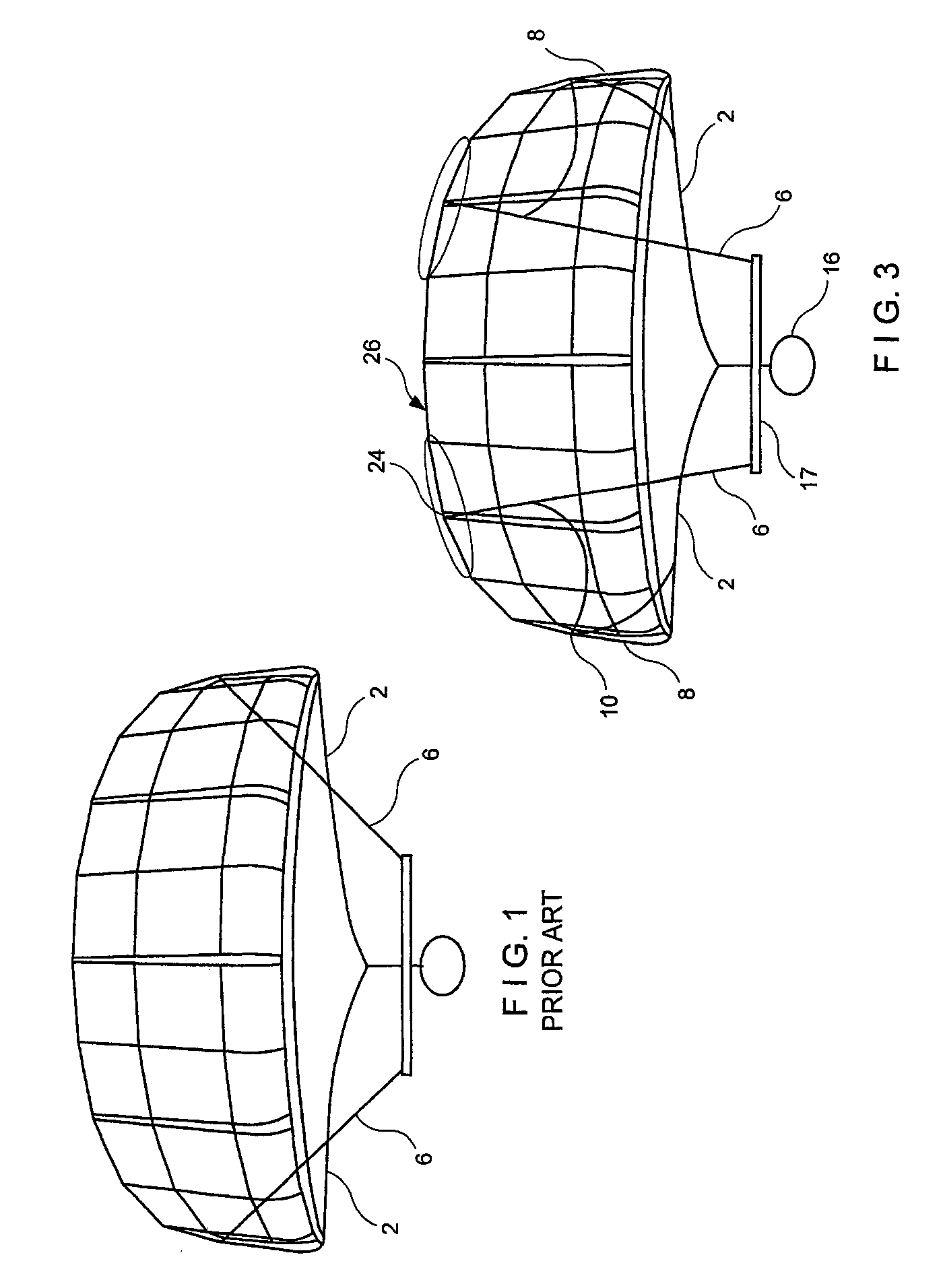
The bridle is the part that made depower real. Spreading the load across many points lets the wing change its angle to the wind instead of simply being on or off.
Drawing sheet 1 from US Patent 6,659,031 B2, "Bridle for power kite launching" (inventor Bruno Legaignoux). United States Patent and Trademark Office. Public domain.Public domain (US government work)patents.google.comDeclared gaps in the record (1)
Research notes, kept in their original English.
- places
US 6,659,031 B2 — Bridle for power kite launching (B. Legaignoux)IKSURFMAG — 100 Moments: A Kitesurfing Timeline (Issue 100)
1 March 2004
The bow kite is filed: a flat middle and a concave trailing edge
Dominique and Bruno Legaignoux filed FR 0402094 on 1 March 2004 for a wing with a negative dihedron whose middle section is held flat by bridle lines that slide through guides on the leading edge. The abstract describes a concave trailing edge. The application published on 2 September 2005 as FR 2 866 859 A1. The US member of the family, US 7,374,133 B2, was filed on 28 February 2005 and published on 20 May 2008. IKSURFMAG dates the bow kite to 2005 and names Cabrinha's Crossbow and Takoon's Nova as the kites that carried it.
Why it mattered: The patent states what the flat middle buys. On a wing flown on more than two lines, letting the rear lines out opens the profile further and takes more power out of the kite in a gust or when the rider loses control.
Sources disagree
Was the flat-centred kite new in 2004?
IKSURFMAG credits the bow kite to a new Legaignoux patent, with Cabrinha and Takoon building the kites.
Does not establish: That no flattened wing was on the market before it.
The patent's own background says wings with a flattened centre were already sold under the GAASTRA and FLEX marks, and presents the invention as a fix for the drag they produced.
Does not establish: That those wings depowered as far, or that anyone called them bow kites.
US 7,374,133 B2 — Wing having a negative dihedron for towing a load (D. and B. Legaignoux)
What is not in doubt: Both agree that a flat centre section is what lets the profile open further when the rear lines are released.
What would settle it: Dated catalogues or test reports for the GAASTRA and FLEX wings the patent names, showing their bridle geometry and how far they depowered.
FR 2 866 859 A1 — Propulsive wing with negative dihedron for towing a load (D. and B. Legaignoux)US 7,374,133 B2 — Wing having a negative dihedron for towing a load (D. and B. Legaignoux)IKSURFMAG — 100 Moments: A Kitesurfing Timeline (Issue 100)
July 2005
France writes a test standard for kite release systems
AFNOR published NF S52-503, an 18-page national standard on reducing or cancelling the pull of a kite and on getting the rider off it. It was drawn up by AFNOR's KITESURF commission and sets separate requirements for the trigger and the releaser, together with test methods and mechanical strength. It also specifies what has to be marked on a product sold in shops.
Why it mattered: A release system now had a written pass mark instead of the maker's word for it. Flysurfer says its own click-in quick release from 2006 never reached production, and names the AFNOR certificate as one of the reasons.
Declared gaps in the record (1)
Research notes, kept in their original English.
- people
AFNOR Editions — NF S52-503, Kitesurf: safety requirements relative to the reduction or counterbalancing of the tensile stress and release-related safety requirements, test methodsAFNOR Norm'Info — NF S52-503, followed by the KITESURF commissionFLYSURFER — 20 Years of FLYSURFER
2 May 2006
A patent writes down what was wrong with the wrist leash
US 7,036,771, filed by Alexander S. Pouchkarev on 9 August 2004 with a priority date of 3 July 2002, published on 2 May 2006. Its background section records the kit riders were using: a four-line traction kite whose front lines gather into a trim loop at the harness, with a wrist leash as the emergency exit. The document then sets out how the leash failed and proposes a trim line running through a release that changes the kite's angle of attack while the rider keeps hold of the bar.
Why it mattered: It puts a date and a document on the problem the chicken loop and the quick release were built to solve. Letting go of the bar took the power out of the kite by crashing it, and the rider was left with tangled lines afterwards.
Declared gaps in the record (1)
Research notes, kept in their original English.
- places
US 7,036,771 B1 — Kite safety, control, and rapid depowering apparatus (A. S. Pouchkarev)IKSURFMAG — 100 Moments: A Kitesurfing Timeline (Issue 100)
Questions
Common questions
What is depower on a kite?+
Depower is the ability to reduce a kite's pull without landing it, by changing the angle at which the wing meets the wind. It is what turned a fixed-power kite into something with a usable range, and it is the reason a single kite can cover conditions that once needed several.
Sources for this page
Every dated claim above traces to the sources listed with it. These are the publications this page is built on.