
History
How the kite
changed
Every kite flying today traces back to one idea from 1984: put an inflatable tube along the leading edge so the thing floats and relaunches.
- 11 milestones
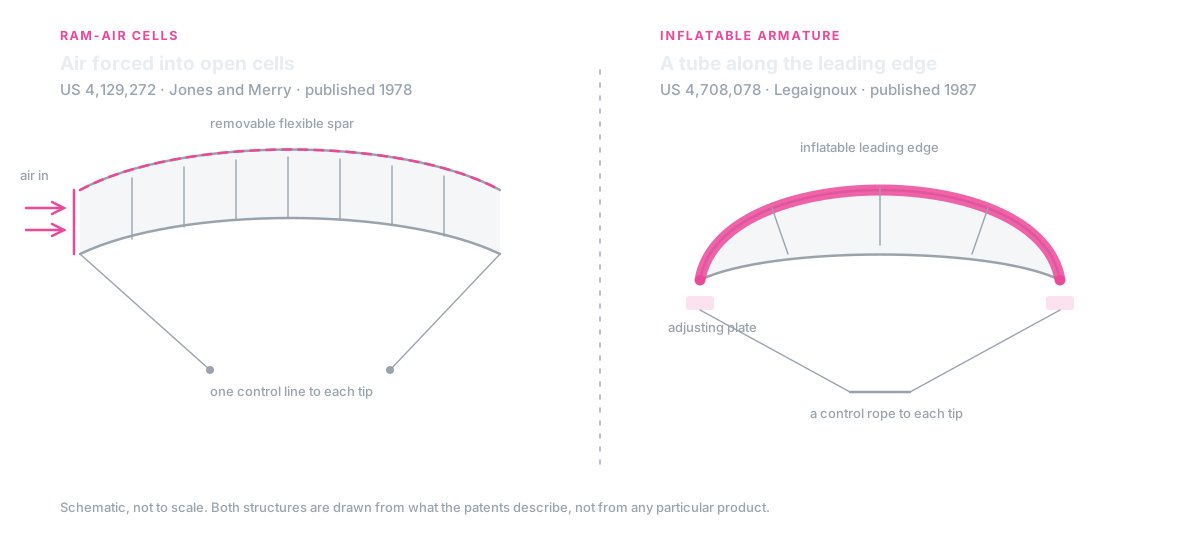 Diagram
Two patented answers to the same problem: how do you hold a fabric wing in shape with no mast? Ram-air kites use the air they fly through. The Legaignoux wing uses a tube you inflate before launching — which is also why it floats, and why it can be flown off the water again.
Diagram: KitesurfingOfficial, drawn from US 4,129,272 and US 4,708,078KitesurfingOfficial, own workA kite has one structural problem and it has never changed: fabric has no shape of its own, and a mast is not an option when the wing has to fly a hundred metres away from you. Everything on this page is somebody's answer to that.
Three answers stuck. Hold the shape with tensioned fabric alone, hold it with air forced into open cells, or hold it with a tube you inflate before you launch. The last one also floats, which is why it won on water. The moves these kites made possible are in the Trick Tree.
The record
How the kite changed
20 March 1951
A wing with no rigid frame
US 2,546,078, "Flexible kite", published. It was filed on 23 November 1948 and it names two inventors: Gertrude Sugden Rogallo and Francis Melvin Rogallo. The Rogallo Foundation records that the couple built the prototypes at home, and that "in 1951 they received a patent for the design".
Why it mattered: The patent is usually credited to Francis alone. Gertrude is named on it first, and the foundation's own account has them working on it together at home — worth stating plainly, because a wing that holds its shape without a frame is the idea both foil and inflatable kites are built on.
US 2,546,078 — Flexible kite (G. S. Rogallo and F. M. Rogallo)The Rogallo Foundation — Francis Rogallo, Hang-Gliding Pioneer
5 May 1964
Cells that inflate themselves
US 3,131,894, "Multi-cell glide canopy parachute", published, filed by Domina C. Jalbert on 10 January 1963. The International Skydiving Museum records it as "the multi-celled canopy which he patented in 1963".
Why it mattered: Air forced into open cells gives a fabric wing its shape with nothing rigid inside. Every foil kite flown today works this way, and the inflatable kite that came later was an answer to the same problem by other means.
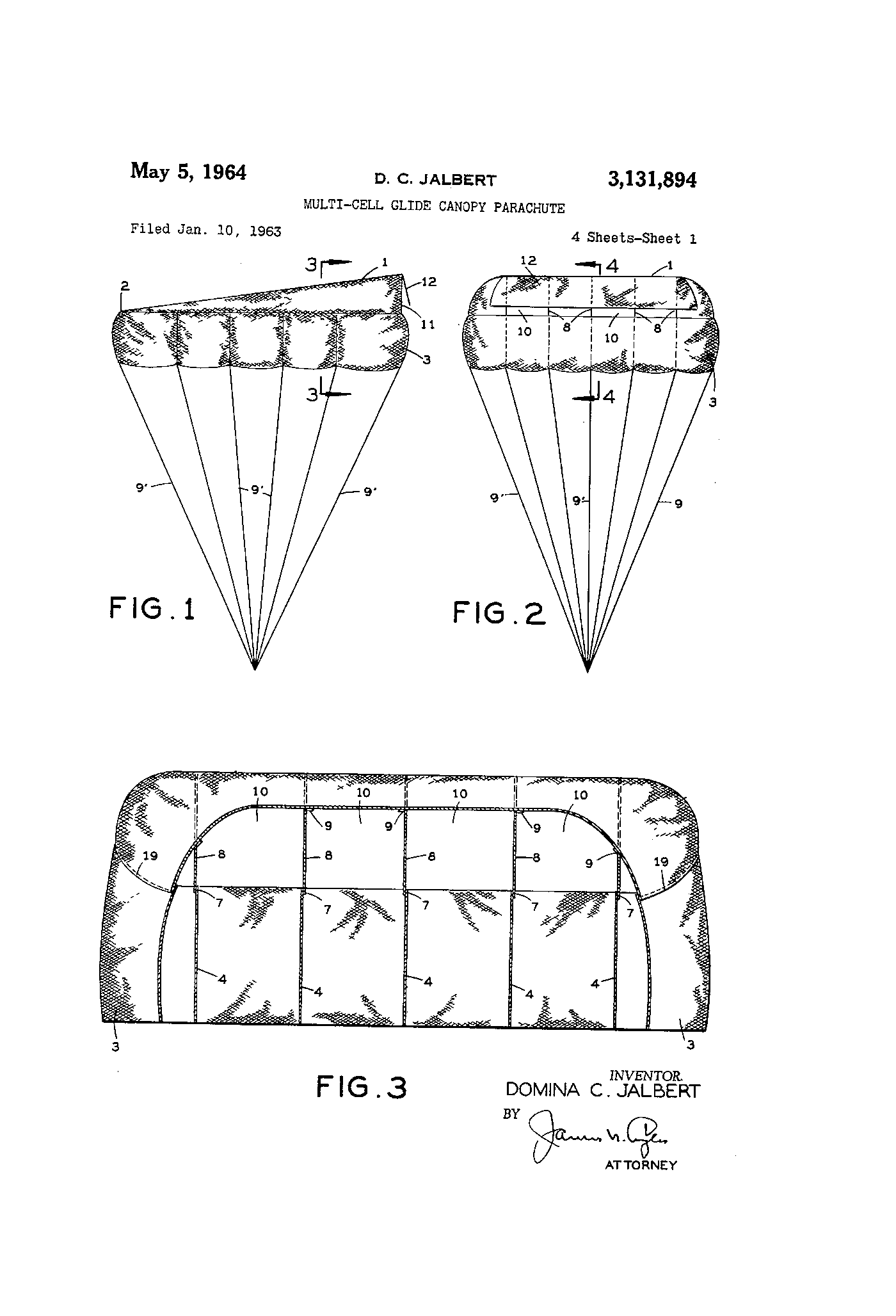
Jalbert's cells, as the patent office drew them. Air forced into open cells gives a fabric wing its shape with nothing rigid inside — the principle every foil kite still uses.
Drawing sheet from US patent 3,131,894, 'Multi-cell glide canopy parachute', D. C. Jalbert. United States Patent and Trademark Office. Public domain.Public domain (US government work)patents.google.comUS 3,131,894 — Multi-cell glide canopy parachute (D. C. Jalbert)International Skydiving Museum & Hall of Fame — Domina C. Jalbert
23 August 1976
A spar in the leading edge, and two lines
The British application behind US 4,129,272, "Aerofoil structure", was filed on 23 August 1976 as GB 35024/76, which is the priority date the US record carries. It names Andrew W. Jones and Raymond Merry and describes a multi-cell fabric envelope inflated by ram air, with a removable flexible spar along the leading edge whose ends anchor a pair of control lines. The US application followed on 19 August 1977 and the patent published on 12 December 1978. The wing was sold as the Flexifoil.
Why it mattered: Jalbert's cells gave a fabric wing its shape but not a way to aim it. The spar is what changes that: put the two lines on the spar ends, pull one, and the wing turns instead of just towing. The specification also lists the thing working as a "kite or as a prime mover for land or water going craft", so pulling a craft over water is in the document rather than read back into it afterwards.
Sources disagree
When was the Flexifoil made: 1972, as the company says, or 1976, the earliest date any document fixes?
Flexifoil's own account puts it in 1972: Ray Merry and Andrew Jones set out to build a wind sculpture and ended up with a power kite, which they named within days.
Does not establish: Nothing dated from the time is offered, and the company's two sites do not agree with each other: one says Cambridge and 1972, the other says Newcastle-upon-Tyne and the early 1970s.
Flexifoil International Ltd — About UsFlexifoil International — About (How it began)
The earliest date any document fixes is 23 August 1976, when the British priority application GB 35024/76 was filed.
Does not establish: A priority date records when protection was applied for, not when the wing was built or flown. It is a latest-possible date for the invention, not the date of it.
US 4,129,272 — Aerofoil structure (A. W. Jones and R. Merry)
What is not in doubt: Both accounts name the same two people and the same wing, and neither contradicts the other on who made it.
What would settle it: Anything dated from before the filing that shows the kite in the air: a captioned photograph, a magazine notice, a sales record.
US 4,129,272 — Aerofoil structure (A. W. Jones and R. Merry)Flexifoil International Ltd — About UsFlexifoil International — About (How it began)
16 November 1984
The inflatable leading edge gets a priority date
Bruno and Dominique Legaignoux filed the wing that every modern kite descends from: a light canopy held in shape by an inflatable armature, with a control rope running to each tip through an adjusting plate. 16 November 1984 is the priority date their later US patent carries.
Why it mattered: The patent covers the wing and the two control ropes running to its tips. That arrangement is what a modern control bar still does.
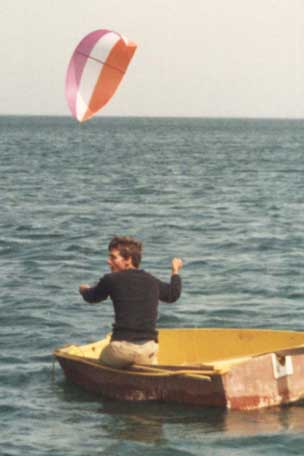
1984, the year the Legaignoux brothers filed the priority application behind their patent. The source records this as their first traction test of a C-kite, flown from a sailboat tender instead of a board.
Brunolgx, CC BY-SA 3.0 (https://creativecommons.org/licenses/by-sa/3.0), via Wikimedia CommonsCC BY-SA 3.0commons.wikimedia.orgSources disagree
Who invented kitesurfing?
Gijsbertus Panhuise holds the earliest patent for the arrangement, filed 8 April 1976 and published 11 October 1977.
Does not establish: That anything was ever built from it, or that anyone rode it.
NL 7603691 — Composition for the practice of water sports (G. A. Panhuise)
The Legaignoux brothers designed the inflatable wing every modern kite descends from, priority 16 November 1984.
Does not establish: That they were first to put a rider on a board behind a kite.
US 4,708,078 — Propulsive wing with inflatable armature (D. and B. Legaignoux)
William and Cory Roeseler's KiteSki was the first kite-and-board system actually sold, patented as US 5,366,182.
Does not establish: That the design line continued: modern kites descend from the inflatable wing, not from the KiteSki.
US 5,366,182 — Kiteski (W. G. Roeseler and C. Roeseler)IKSURFMAG — 100 Moments: A Kitesurfing Timeline (Issue 100)
Dieter Strasilla was granted US 4,127,247 for wind propulsion of a person, with a priority date of 6 May 1976.
Does not establish: A water claim: the patent is addressed to skiers, and its priority falls a month after Panhuise's filing.
What is not in doubt: The four filings are real and their dates are not in doubt. What is contested is which of them counts as the invention.
What would settle it: A dated, independently witnessed record of someone riding a board pulled by a kite before 8 April 1976. None has been produced.
US 4,708,078 — Propulsive wing with inflatable armature (D. and B. Legaignoux)IKSURFMAG — 100 Moments: A Kitesurfing Timeline (Issue 100)IKSURFMAG — Who invented kitesurfing?
24 November 1987
US 4,708,078 publishes
The United States Patent and Trademark Office published the Legaignoux wing as US 4,708,078, "Propulsive wing with inflatable armature" — three years after the French priority filing and two years after the US application of 8 November 1985.
Why it mattered: One document carries three dates, which is why sources date this invention to 1984, to 1985 and to 1987 and each of them is quoting something real.
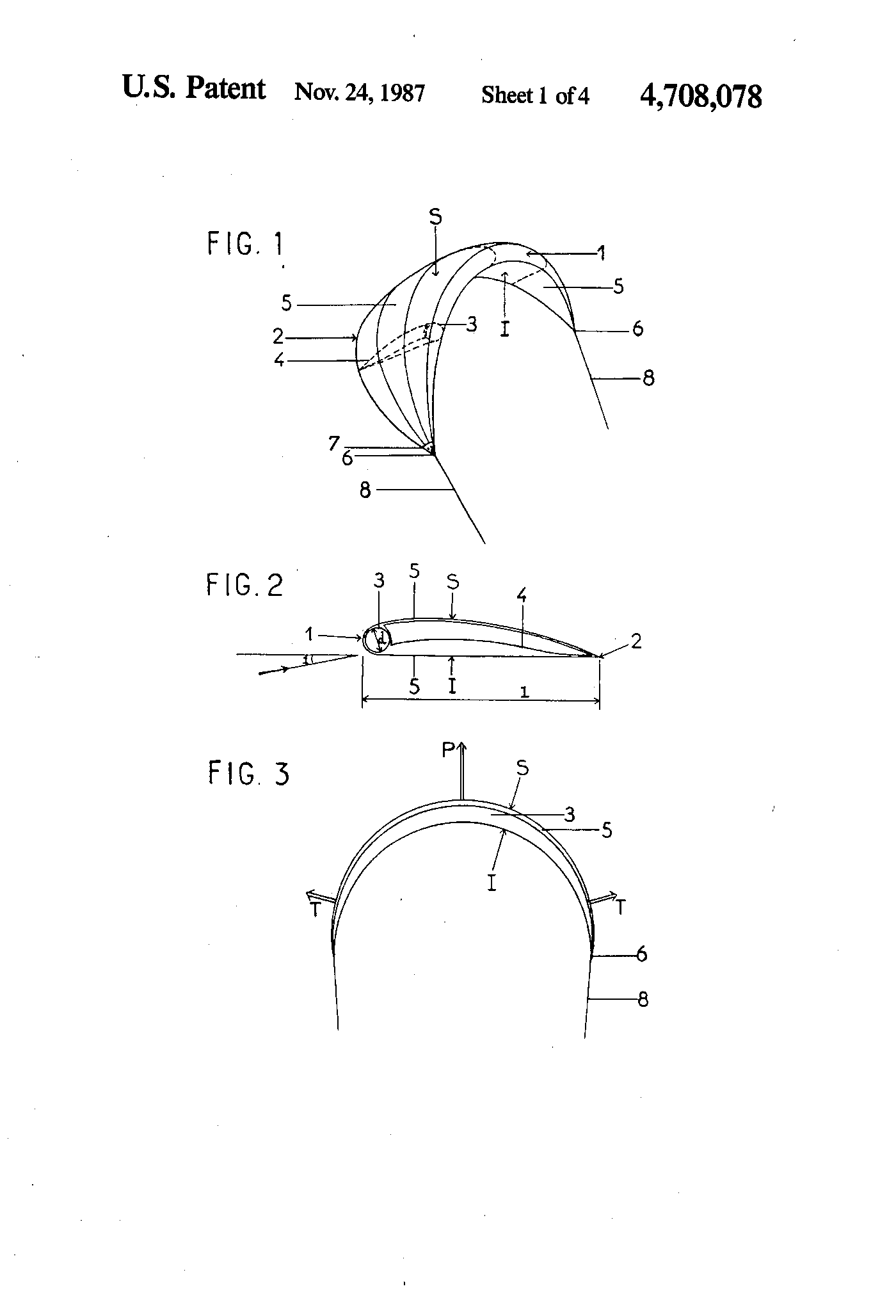
Sheet 1 sets out the shape. The wing holds its curve from an inflated tube along the leading edge rather than a rigid frame, and figure 2 shows the section working the way an aircraft wing does.
US Patent 4,708,078, "Propulsive wing with inflatable armature", Bruno T. Legaignoux and Dominique M. Legaignoux, granted 24 November 1987, drawing sheet 1 of 4. Public domain US patent document, United States Patent and Trademark Office.Public domain (US government work)patents.google.com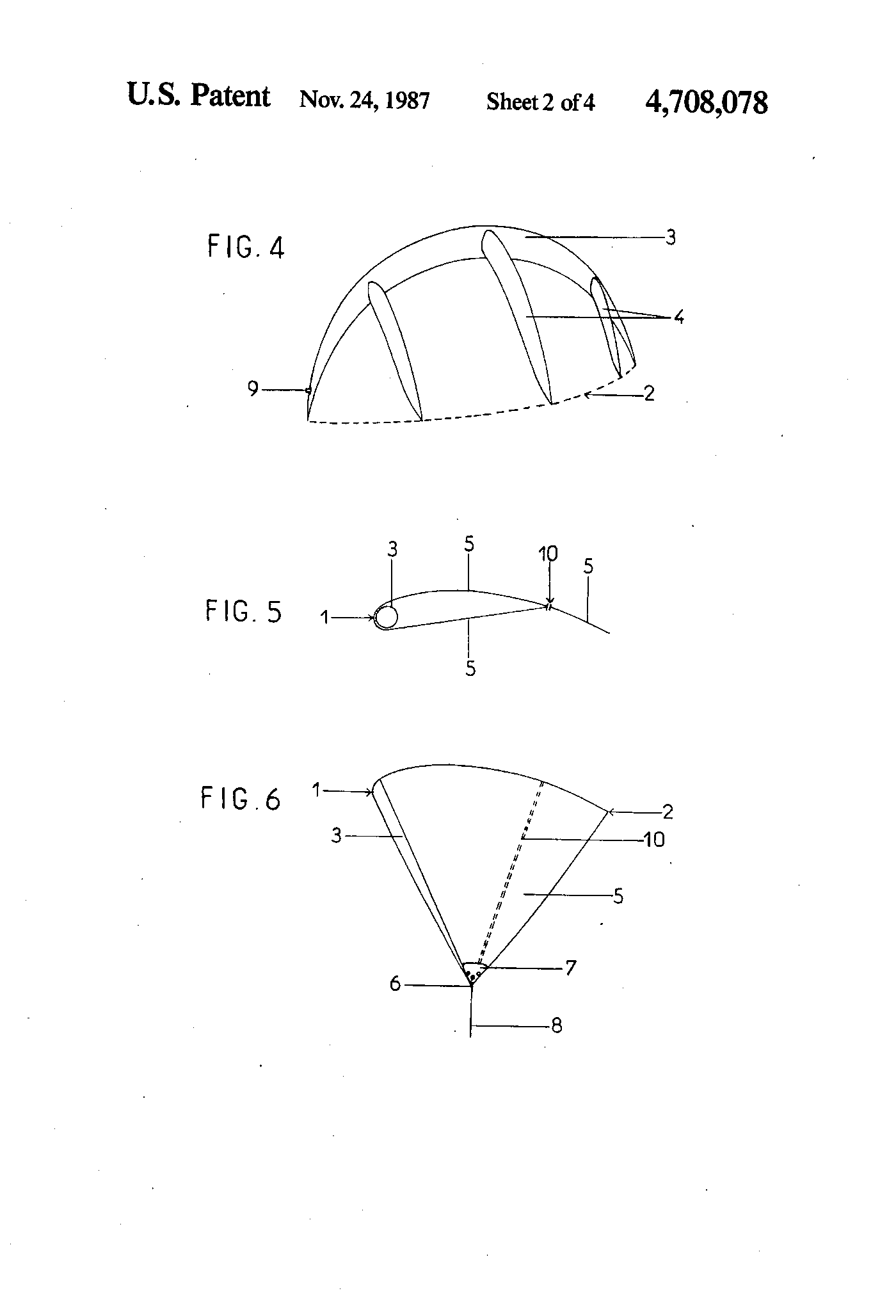
Sheet 2 shows the structure on its own. Figure 4 is the armature without its fabric, a leading-edge tube with tapering ribs, inflated through the ports marked 9 using what the text calls an inflatable boat pump.
US Patent 4,708,078, "Propulsive wing with inflatable armature", Bruno T. Legaignoux and Dominique M. Legaignoux, granted 24 November 1987, drawing sheet 2 of 4. Public domain US patent document, United States Patent and Trademark Office.Public domain (US government work)patents.google.com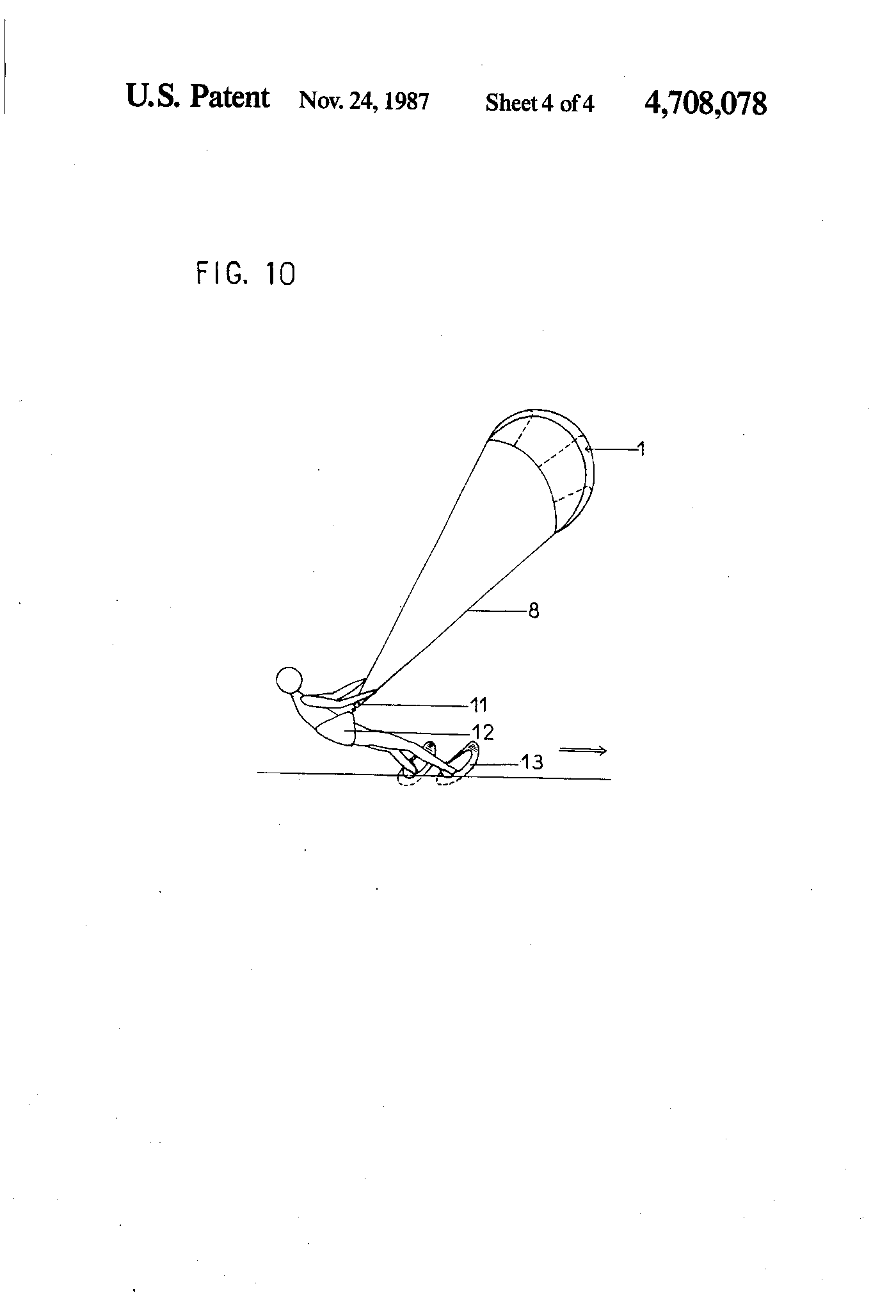
The patent did not only describe a kite. It described the kite pulling something, with a rope to each tip — the arrangement a modern bar still uses.
Drawing sheet from US Patent 4,708,078, "Propulsive wing with inflatable armature", B. T. and D. M. Legaignoux. United States Patent and Trademark Office. Public domain.Public domain (US government work)patents.google.comUS 4,708,078 — Propulsive wing with inflatable armature (D. and B. Legaignoux)IKSURFMAG — Who invented kitesurfing?
1997
The Wipika goes on sale
Bruno and Dominique Legaignoux put their inflatable kite on the market as the Wipika, flown on two lines. A year later a Maui paper called it the newest development in the sport and described it as an inflatable waterproof kite.
Why it mattered: The inflated tubes held the shape in the air and floated the kite when it went down, and the Maui paper credited the design with making the sport testable in the island's heavy conditions.
Declared gaps in the record (2)
Research notes, kept in their original English.
- equipment: no source we could open says the Wipika relaunched from the water. IKSURFMAG attaches water relaunch to the 1994 KiteSki and describes flotation as a property of the Legaignoux design, not of the Wipika product
- date: 1997 comes from IKSURFMAG's timeline; the July 1998 MauiTime issue only shows the kite already in use
IKSURFMAG — 100 Moments: A Kitesurfing Timeline (Issue 100)MauiTime — Talking Story with Maui Kite Surfers (issue of 21 July 1998, by Dave Sweedler)
1997
F-ONE puts a kiteboard in the shops
F-ONE released the red 215, a board built for a kite rather than carried over from windsurfing. The company's own history says it "became the only one to offer such a board on the market worldwide".
Why it mattered: The new sport now had a board a shop could stock. IKSURFMAG counts F-ONE among the brands that made kiteboards readily available to the young market.
Sources disagree
When did F-ONE start?
F-ONE's own history dates the company to 1994, working on windsurf boards, and puts the red 215 kiteboard three years later.
Does not establish: The page shows no registration record, and it does not say when kites rather than windsurf boards became the business.
F-ONE — Notre histoire (the company's own founding account, in French)
IKSURFMAG's timeline dates the founding to 1997, the same year as the kiteboard.
Does not establish: The entry names no document behind the year, and it is written about the kiteboard rather than about the company's registration.
What is not in doubt: Both put an F-ONE kiteboard on the market in 1997.
What would settle it: The French company register entry for F-ONE, which carries an incorporation date.
Declared gaps in the record (2)
Research notes, kept in their original English.
- date: the founding year is contested between the company's own history (1994) and IKSURFMAG (1997); the French company register would settle it
- equipment: no source gives the red 215's dimensions or construction
F-ONE — Notre histoire (the company's own founding account, in French)IKSURFMAG — 100 Moments: A Kitesurfing Timeline (Issue 100)
1999
Naish licenses the inflatable
Naish Sails Hawaii brought out an inflatable kite, the AR3.5, under a licensing deal with the Legaignoux brothers. Robby Naish had been developing his own line of kites through the late 1990s and was racing on them.
Why it mattered: A windsurf brand was now selling kites, and the rider whose name it carried won the kiteboarding slalom world title in 1998 and both the slalom and jumping titles in 1999.
Declared gaps in the record (2)
Research notes, kept in their original English.
- equipment: the AR3.5 and the licence rest on IKSURFMAG alone; no Naish document we could open names or dates the kite
- date: 1999 is IKSURFMAG's dating; the two halls of fame date only the competition titles
IKSURFMAG — 100 Moments: A Kitesurfing Timeline (Issue 100)Outrigger Duke Kahanamoku Foundation — Hawaii Waterman Hall of Fame: Robby NaishThe Sailing Museum & National Sailing Hall of Fame — Robert "Robby" Staunton Naish (citation by Gary Jobson)
9 December 2003
The four-line bridle that gets a downed kite back up
Bruno Legaignoux's US 6,659,031 B2 published on 9 December 2003. It describes a kite flown on two front and two rear lines, with a pulley at each wing tip and a pair of auxiliary lines running from the rear lines to the trailing edge. Pulling the rear lines then drags the canopy off its leading edge and back into the air. The same document carries a priority date of 7 November 2000 and a US filing date of 19 April 2001, which is why accounts of it name three different years. It cites the brothers' own earlier inflatable wing, US 4,708,078.
Why it mattered: The patent says the problem in its own words: the bigger the kite, the harder it is to get back up once it has fallen on its leading edge. Its stated aim is relaunch on the same four lines the rider already flies, with no extra lines running to the trailing edge.
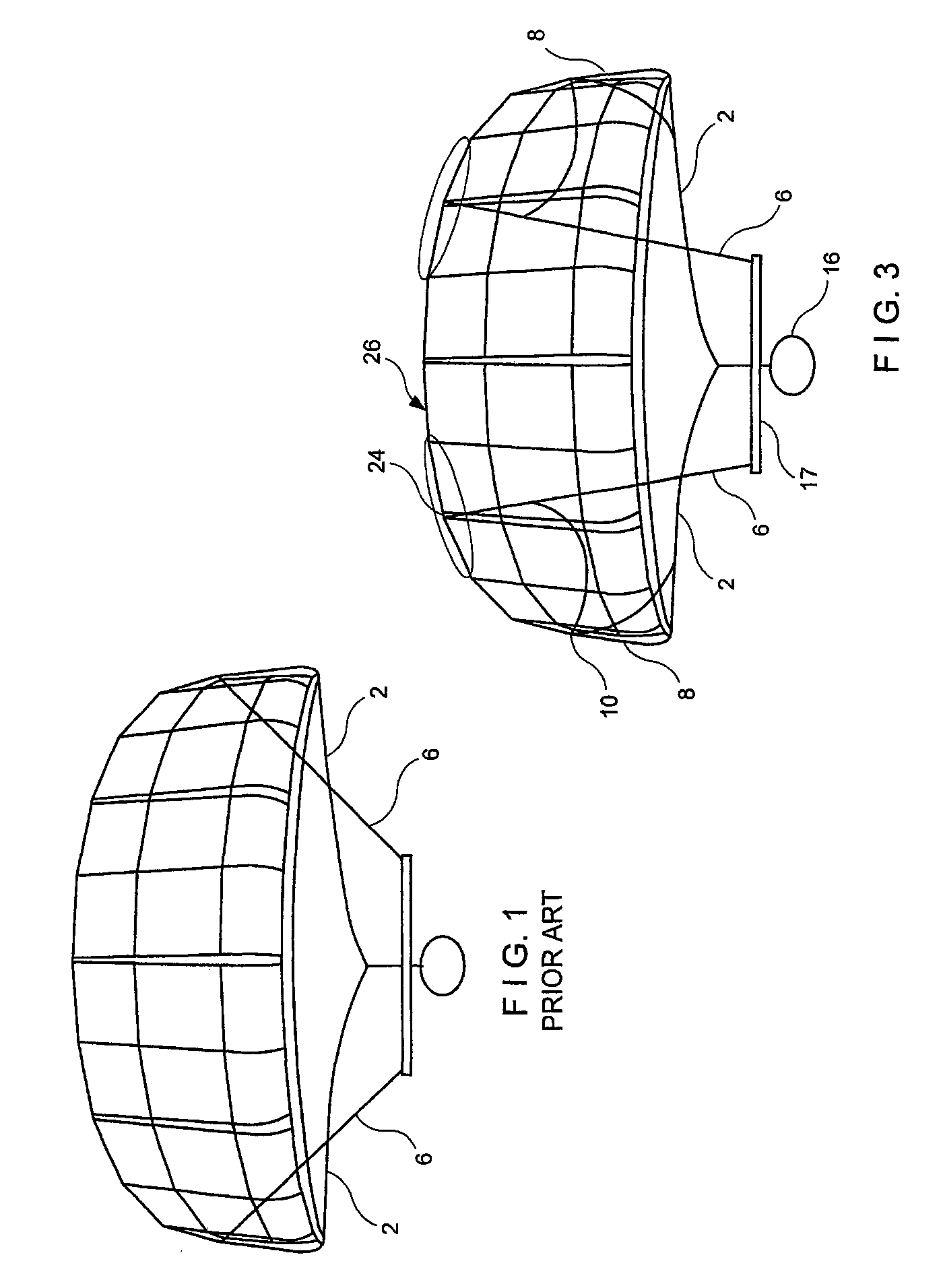
The bridle is the part that made depower real. Spreading the load across many points lets the wing change its angle to the wind instead of simply being on or off.
Drawing sheet 1 from US Patent 6,659,031 B2, "Bridle for power kite launching" (inventor Bruno Legaignoux). United States Patent and Trademark Office. Public domain.Public domain (US government work)patents.google.comDeclared gaps in the record (1)
Research notes, kept in their original English.
- places
US 6,659,031 B2 — Bridle for power kite launching (B. Legaignoux)IKSURFMAG — 100 Moments: A Kitesurfing Timeline (Issue 100)
1 March 2004
The bow kite is filed: a flat middle and a concave trailing edge
Dominique and Bruno Legaignoux filed FR 0402094 on 1 March 2004 for a wing with a negative dihedron whose middle section is held flat by bridle lines that slide through guides on the leading edge. The abstract describes a concave trailing edge. The application published on 2 September 2005 as FR 2 866 859 A1. The US member of the family, US 7,374,133 B2, was filed on 28 February 2005 and published on 20 May 2008. IKSURFMAG dates the bow kite to 2005 and names Cabrinha's Crossbow and Takoon's Nova as the kites that carried it.
Why it mattered: The patent states what the flat middle buys. On a wing flown on more than two lines, letting the rear lines out opens the profile further and takes more power out of the kite in a gust or when the rider loses control.
Sources disagree
Was the flat-centred kite new in 2004?
IKSURFMAG credits the bow kite to a new Legaignoux patent, with Cabrinha and Takoon building the kites.
Does not establish: That no flattened wing was on the market before it.
The patent's own background says wings with a flattened centre were already sold under the GAASTRA and FLEX marks, and presents the invention as a fix for the drag they produced.
Does not establish: That those wings depowered as far, or that anyone called them bow kites.
US 7,374,133 B2 — Wing having a negative dihedron for towing a load (D. and B. Legaignoux)
What is not in doubt: Both agree that a flat centre section is what lets the profile open further when the rear lines are released.
What would settle it: Dated catalogues or test reports for the GAASTRA and FLEX wings the patent names, showing their bridle geometry and how far they depowered.
FR 2 866 859 A1 — Propulsive wing with negative dihedron for towing a load (D. and B. Legaignoux)US 7,374,133 B2 — Wing having a negative dihedron for towing a load (D. and B. Legaignoux)IKSURFMAG — 100 Moments: A Kitesurfing Timeline (Issue 100)
2 May 2006
A patent writes down what was wrong with the wrist leash
US 7,036,771, filed by Alexander S. Pouchkarev on 9 August 2004 with a priority date of 3 July 2002, published on 2 May 2006. Its background section records the kit riders were using: a four-line traction kite whose front lines gather into a trim loop at the harness, with a wrist leash as the emergency exit. The document then sets out how the leash failed and proposes a trim line running through a release that changes the kite's angle of attack while the rider keeps hold of the bar.
Why it mattered: It puts a date and a document on the problem the chicken loop and the quick release were built to solve. Letting go of the bar took the power out of the kite by crashing it, and the rider was left with tangled lines afterwards.
Declared gaps in the record (1)
Research notes, kept in their original English.
- places
US 7,036,771 B1 — Kite safety, control, and rapid depowering apparatus (A. S. Pouchkarev)IKSURFMAG — 100 Moments: A Kitesurfing Timeline (Issue 100)
Questions
Common questions
Why does a kitesurfing kite have inflatable tubes?+
To keep its shape without a rigid frame, and to float. US 4,708,078 describes a wing held by an inflatable armature under a flexible envelope. A tube full of air holds the leading edge open, and it also means a kite that lands on the water sits on the surface instead of sinking — which is what makes it recoverable.
What is a foil kite and how is it different?+
A foil kite has no inflatable structure at all. It is a multi-cell envelope, open at the front, that fills with the air it flies through — the principle Domina Jalbert patented as a glide canopy in the early 1960s. It packs smaller and flies efficiently, but the cells fill with water if it lands, which is the trade an inflatable kite avoids.
Sources for this page
Every dated claim above traces to the sources listed with it. These are the publications this page is built on.