
History · 1820s–1976
Before
kitesurfing
People were using kites to pull carriages, boats and skis for more than a century before anyone stood on a board behind one.
- 1820s–1976
- 5 milestones
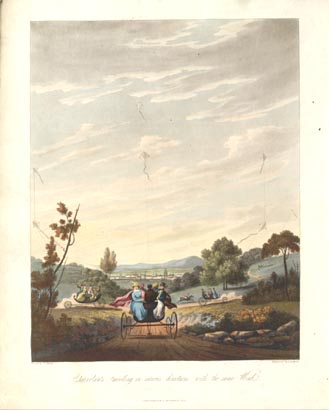
The claim Pocock most wanted to sell, and the one that matters here: carriages under the same wind, travelling in different directions. Riding across the wind rather than straight downwind is the idea kitesurfing still runs on.
'Charvolants travelling in various directions with the same Wind', 1827. University of Glasgow Library, Special Collections, via Wikimedia Commons. Public domain.Public domaincommons.wikimedia.orgNobody in this era was kitesurfing, and none of them were trying to. They were solving a narrower problem: how do you get a fabric wing to hold its shape and pull something, with no mast and no rigid frame? Every answer they found is still in the kite you fly.
Two of the three patents below are usually credited to one person and were filed by two. Where the document and the popular account disagree, this page follows the document.
The record
Before kitesurfing
1826
A carriage pulled by two kites
George Pocock patented the Charvolant, a carriage pulled by two kites on lines about 450 metres long. A plate from his 1827 treatise, held by the University of Glasgow, shows the rig alongside a compass rose of sailing angles.
Why it mattered: The compass rose is the part that matters. Pocock was not just being towed downwind; he was working out how far across the wind a kite could pull a load, which is the whole trick kitesurfing later depends on.
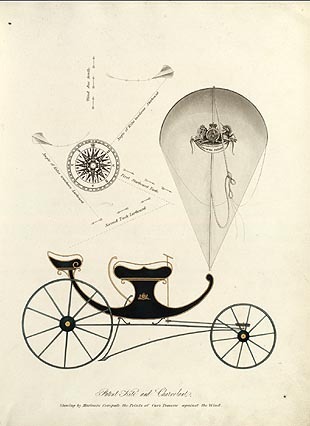
Pocock's Charvolant, drawn for his 1827 treatise. The compass rose matters as much as the carriage: he was already working out how far across the wind a kite could pull a load.
Plate from George Pocock's 1827 treatise on kite traction. University of Glasgow Library, Special Collections, via Wikimedia Commons. Public domain.Public domaincommons.wikimedia.orgIKSURFMAG — 100 Moments: A Kitesurfing Timeline (Issue 100)Wikimedia Commons — Charvolant (1827 plate, University of Glasgow Library, Special Collections)
6 November 1903
A kite pulls a boat across the Channel
Samuel Franklin Cody found the wind wrong at Dover on 5 November 1903, took his boat and kite to Calais on the 11am mail boat, and launched there at 7.30pm behind a two-year-old kite he called Old Faithful. He landed on the beach at Dover at 8.30 the following morning. The wind dropped twice on the way over and the kite had to be pulled down and lashed to the mast.
Why it mattered: Everything that makes kite traction hard on water shows up in this one trip: the wind drops, the kite comes down, and the tide moves you while you get it back up. Cody had already sailed four hours behind a kite on the Thames that year, so the Channel was about distance rather than about whether the idea worked at all.
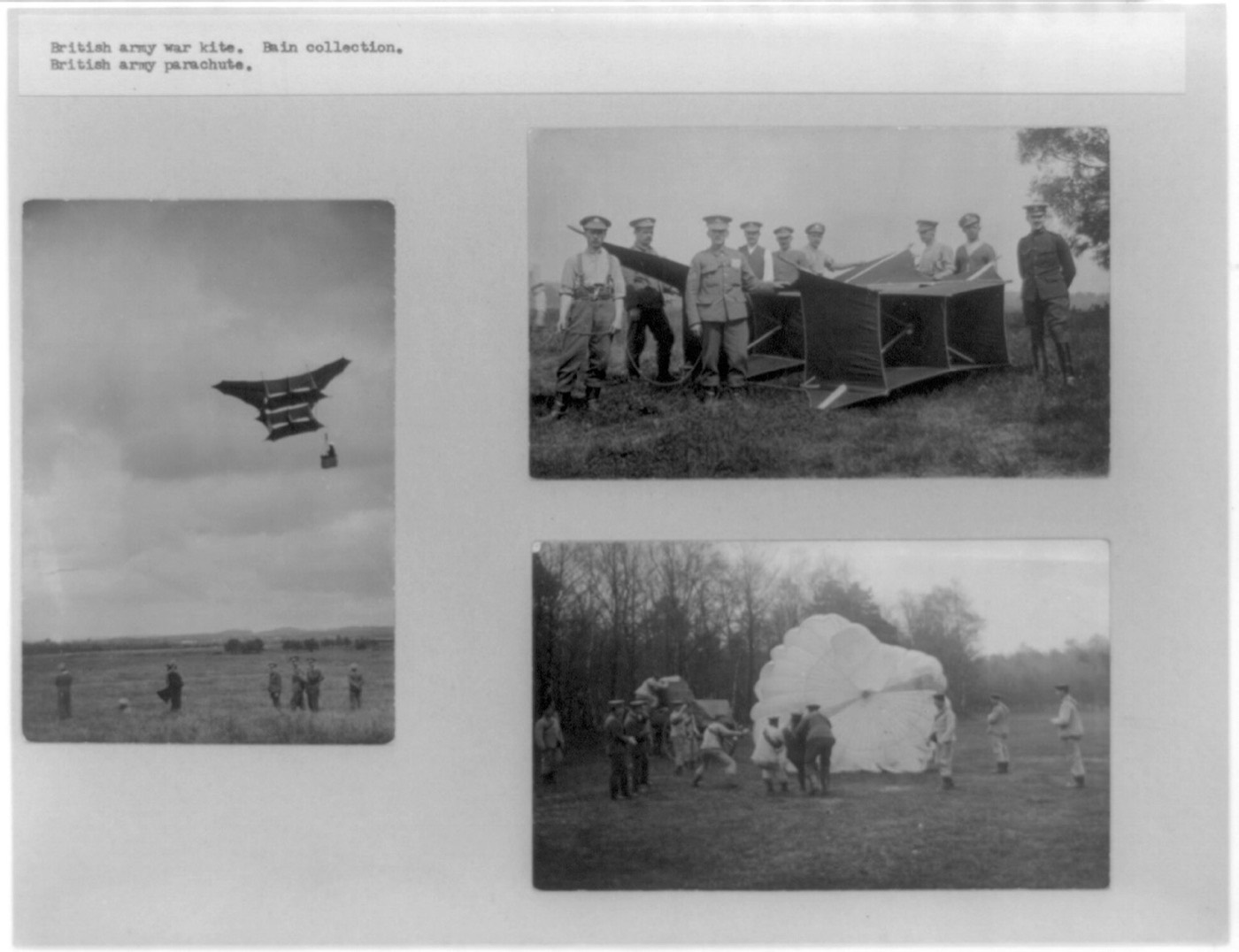
A British Army war kite in 1911, of the man-lifting type Cody had been building. It is not the Channel crossing — it is what the same kites were doing a few years later, and it shows the load they could take.
George Grantham Bain Collection, Library of Congress, Prints and Photographs Division (LC catalog 96509542). No known restrictions on publication.Public domaincommons.wikimedia.orgDeclared gaps in the record (1)
Research notes, kept in their original English.
- equipment
Jean Roberts — The Life of Samuel Franklin Cody: Kites (with material credited to The Drachen Foundation)IKSURFMAG — 100 Moments: A Kitesurfing Timeline (Issue 100)Grace's Guide to British Industrial History — Samuel Franklin Cody
20 March 1951
A wing with no rigid frame
US 2,546,078, "Flexible kite", published. It was filed on 23 November 1948 and it names two inventors: Gertrude Sugden Rogallo and Francis Melvin Rogallo. The Rogallo Foundation records that the couple built the prototypes at home, and that "in 1951 they received a patent for the design".
Why it mattered: The patent is usually credited to Francis alone. Gertrude is named on it first, and the foundation's own account has them working on it together at home — worth stating plainly, because a wing that holds its shape without a frame is the idea both foil and inflatable kites are built on.
US 2,546,078 — Flexible kite (G. S. Rogallo and F. M. Rogallo)The Rogallo Foundation — Francis Rogallo, Hang-Gliding Pioneer
5 May 1964
Cells that inflate themselves
US 3,131,894, "Multi-cell glide canopy parachute", published, filed by Domina C. Jalbert on 10 January 1963. The International Skydiving Museum records it as "the multi-celled canopy which he patented in 1963".
Why it mattered: Air forced into open cells gives a fabric wing its shape with nothing rigid inside. Every foil kite flown today works this way, and the inflatable kite that came later was an answer to the same problem by other means.
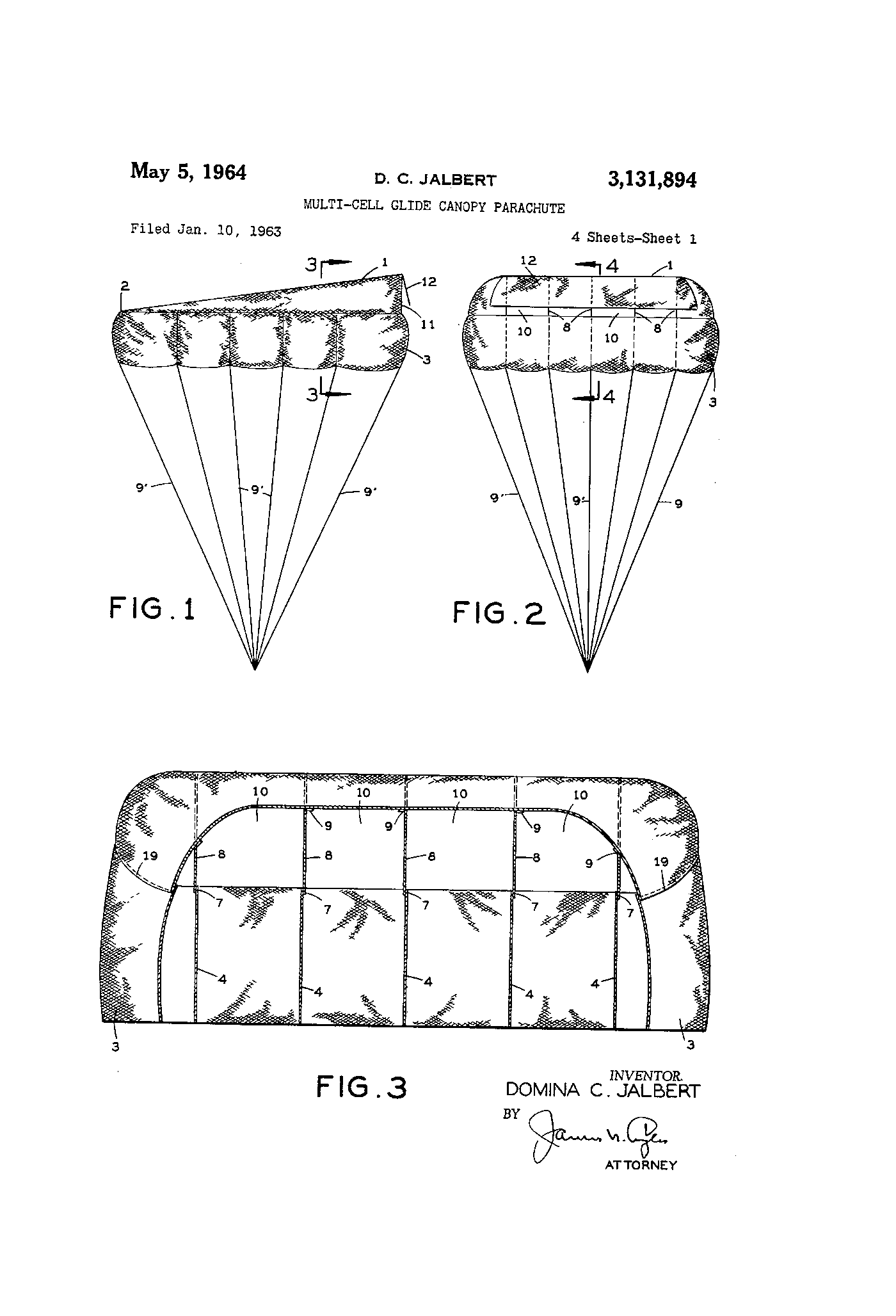
Jalbert's cells, as the patent office drew them. Air forced into open cells gives a fabric wing its shape with nothing rigid inside — the principle every foil kite still uses.
Drawing sheet from US patent 3,131,894, 'Multi-cell glide canopy parachute', D. C. Jalbert. United States Patent and Trademark Office. Public domain.Public domain (US government work)patents.google.comUS 3,131,894 — Multi-cell glide canopy parachute (D. C. Jalbert)International Skydiving Museum & Hall of Fame — Domina C. Jalbert
23 August 1976
A spar in the leading edge, and two lines
The British application behind US 4,129,272, "Aerofoil structure", was filed on 23 August 1976 as GB 35024/76, which is the priority date the US record carries. It names Andrew W. Jones and Raymond Merry and describes a multi-cell fabric envelope inflated by ram air, with a removable flexible spar along the leading edge whose ends anchor a pair of control lines. The US application followed on 19 August 1977 and the patent published on 12 December 1978. The wing was sold as the Flexifoil.
Why it mattered: Jalbert's cells gave a fabric wing its shape but not a way to aim it. The spar is what changes that: put the two lines on the spar ends, pull one, and the wing turns instead of just towing. The specification also lists the thing working as a "kite or as a prime mover for land or water going craft", so pulling a craft over water is in the document rather than read back into it afterwards.
Sources disagree
When was the Flexifoil made: 1972, as the company says, or 1976, the earliest date any document fixes?
Flexifoil's own account puts it in 1972: Ray Merry and Andrew Jones set out to build a wind sculpture and ended up with a power kite, which they named within days.
Does not establish: Nothing dated from the time is offered, and the company's two sites do not agree with each other: one says Cambridge and 1972, the other says Newcastle-upon-Tyne and the early 1970s.
Flexifoil International Ltd — About UsFlexifoil International — About (How it began)
The earliest date any document fixes is 23 August 1976, when the British priority application GB 35024/76 was filed.
Does not establish: A priority date records when protection was applied for, not when the wing was built or flown. It is a latest-possible date for the invention, not the date of it.
US 4,129,272 — Aerofoil structure (A. W. Jones and R. Merry)
What is not in doubt: Both accounts name the same two people and the same wing, and neither contradicts the other on who made it.
What would settle it: Anything dated from before the filing that shows the kite in the air: a captioned photograph, a magazine notice, a sales record.
US 4,129,272 — Aerofoil structure (A. W. Jones and R. Merry)Flexifoil International Ltd — About UsFlexifoil International — About (How it began)
Questions
Common questions
Who first used a kite to pull something?+
Kite traction is far older than any patent, but the earliest well-documented rig in Europe is George Pocock's Charvolant, patented in 1826: a carriage pulled by two kites on lines around 450 metres long. It has no direct line of descent to kitesurfing — it shows the idea was already understood.
Did Francis Rogallo invent the flexible wing on his own?+
No. US 2,546,078 names Gertrude Sugden Rogallo and Francis Melvin Rogallo, with Gertrude listed first, and the Rogallo Foundation describes the two of them building prototypes at home. The wing is almost always credited to him alone.
Sources for this page
Every dated claim above traces to the sources listed with it. These are the publications this page is built on.