
History · 1977–1995
Who invented
kitesurfing?
Kitesurfing has no single inventor: a Dutch patent, a French inflatable kite and an American ski rig each solved a different part of the problem.
- 1977–1995
- 4 milestones
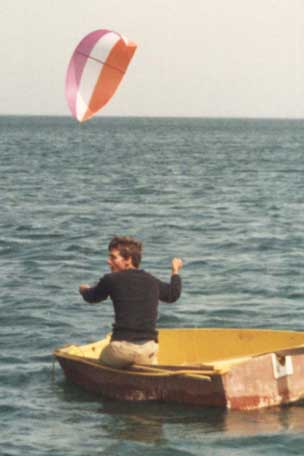
1984, the year the Legaignoux brothers filed the priority application behind their patent. The source records this as their first traction test of a C-kite, flown from a sailboat tender instead of a board.
Brunolgx, CC BY-SA 3.0 (https://creativecommons.org/licenses/by-sa/3.0), via Wikimedia CommonsCC BY-SA 3.0commons.wikimedia.orgAsk who invented kitesurfing and you get four answers, each with a document behind it. That is not evasion: four people solved different parts of the problem, and the sport needed all four solutions before it worked.
Everything below is dated from the patents themselves rather than from recollection, because a patent office records a filing date whether or not anyone remembers it that way. Where the documents disagree with the popular account, the documents win. The moves those kites eventually made are in the Trick Tree.
The record
Who invented kitesurfing?
11 October 1977
The Dutch patent nobody built
The Dutch patent office published NL 7603691, "Composition for the practice of water sports", filed by Gijsbertus Adrianus Panhuise on 8 April 1976. It is the earliest patent document anyone has produced for a rider standing on a floating board and pulled by a kite.
Why it mattered: No equipment is known to have been built from it. The patent settles a question about paperwork, not about who first rode.
NL 7603691 — Composition for the practice of water sports (G. A. Panhuise)IKSURFMAG — 100 Moments: A Kitesurfing Timeline (Issue 100)
16 November 1984
The inflatable leading edge gets a priority date
Bruno and Dominique Legaignoux filed the wing that every modern kite descends from: a light canopy held in shape by an inflatable armature, with a control rope running to each tip through an adjusting plate. 16 November 1984 is the priority date their later US patent carries.
Why it mattered: The patent covers the wing and the two control ropes running to its tips. That arrangement is what a modern control bar still does.
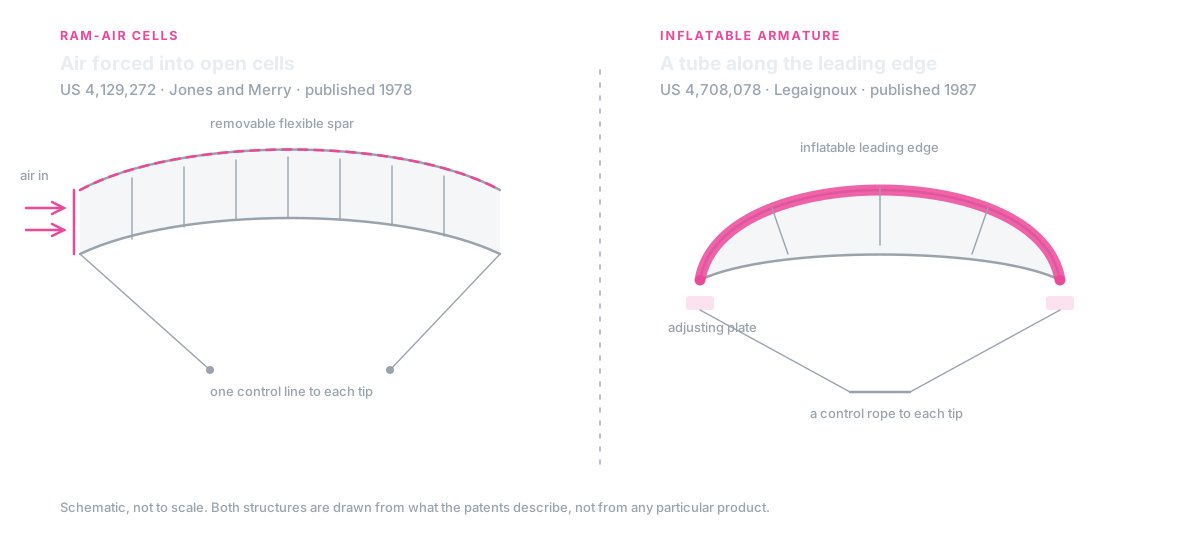 Diagram
Two patented answers to the same problem: how do you hold a fabric wing in shape with no mast? Ram-air kites use the air they fly through. The Legaignoux wing uses a tube you inflate before launching — which is also why it floats, and why it can be flown off the water again.
Diagram: KitesurfingOfficial, drawn from US 4,129,272 and US 4,708,078KitesurfingOfficial, own workSources disagree
Who invented kitesurfing?
Gijsbertus Panhuise holds the earliest patent for the arrangement, filed 8 April 1976 and published 11 October 1977.
Does not establish: That anything was ever built from it, or that anyone rode it.
NL 7603691 — Composition for the practice of water sports (G. A. Panhuise)
The Legaignoux brothers designed the inflatable wing every modern kite descends from, priority 16 November 1984.
Does not establish: That they were first to put a rider on a board behind a kite.
US 4,708,078 — Propulsive wing with inflatable armature (D. and B. Legaignoux)
William and Cory Roeseler's KiteSki was the first kite-and-board system actually sold, patented as US 5,366,182.
Does not establish: That the design line continued: modern kites descend from the inflatable wing, not from the KiteSki.
US 5,366,182 — Kiteski (W. G. Roeseler and C. Roeseler)IKSURFMAG — 100 Moments: A Kitesurfing Timeline (Issue 100)
Dieter Strasilla was granted US 4,127,247 for wind propulsion of a person, with a priority date of 6 May 1976.
Does not establish: A water claim: the patent is addressed to skiers, and its priority falls a month after Panhuise's filing.
What is not in doubt: The four filings are real and their dates are not in doubt. What is contested is which of them counts as the invention.
What would settle it: A dated, independently witnessed record of someone riding a board pulled by a kite before 8 April 1976. None has been produced.
US 4,708,078 — Propulsive wing with inflatable armature (D. and B. Legaignoux)IKSURFMAG — 100 Moments: A Kitesurfing Timeline (Issue 100)IKSURFMAG — Who invented kitesurfing?
24 November 1987
US 4,708,078 publishes
The United States Patent and Trademark Office published the Legaignoux wing as US 4,708,078, "Propulsive wing with inflatable armature" — three years after the French priority filing and two years after the US application of 8 November 1985.
Why it mattered: One document carries three dates, which is why sources date this invention to 1984, to 1985 and to 1987 and each of them is quoting something real.
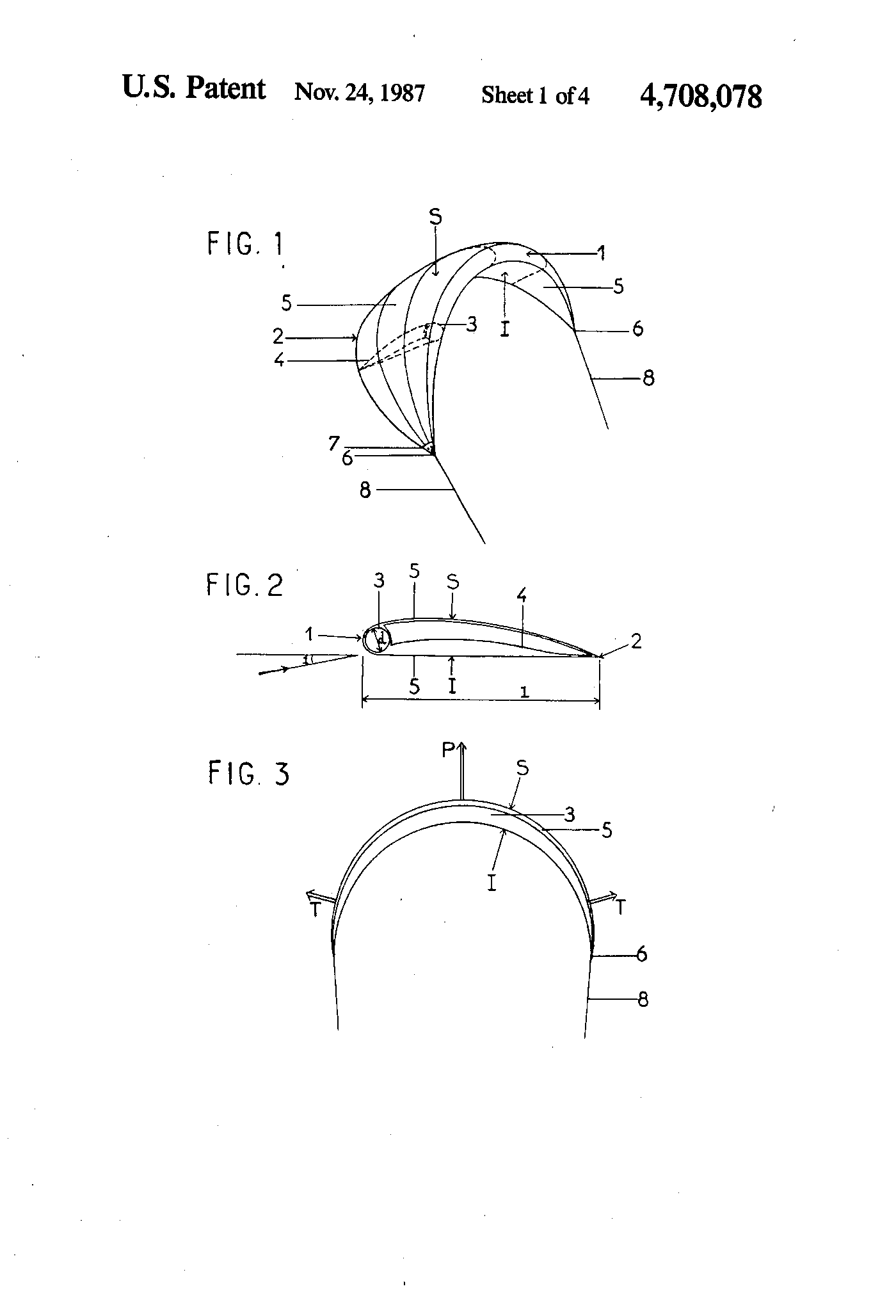
Sheet 1 sets out the shape. The wing holds its curve from an inflated tube along the leading edge rather than a rigid frame, and figure 2 shows the section working the way an aircraft wing does.
US Patent 4,708,078, "Propulsive wing with inflatable armature", Bruno T. Legaignoux and Dominique M. Legaignoux, granted 24 November 1987, drawing sheet 1 of 4. Public domain US patent document, United States Patent and Trademark Office.Public domain (US government work)patents.google.com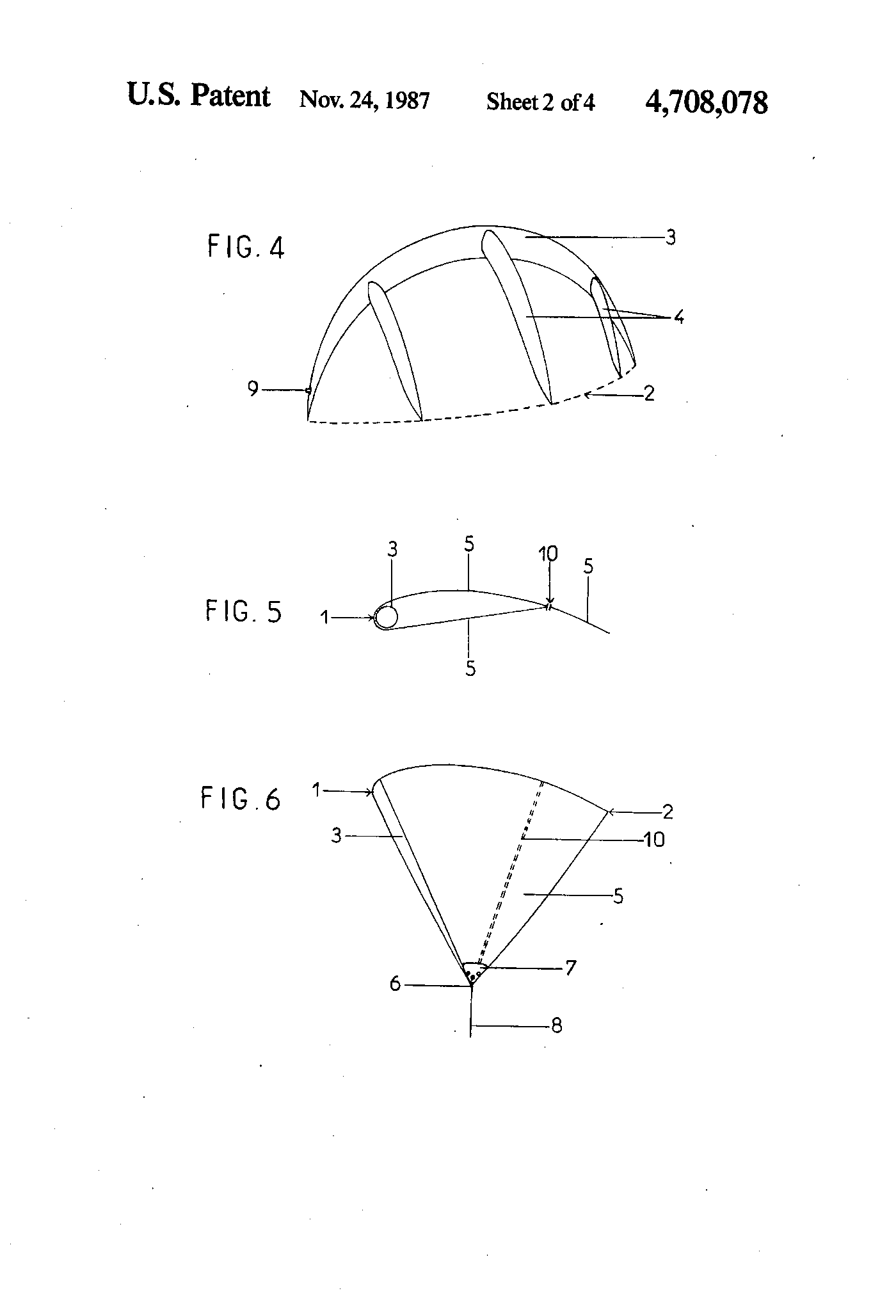
Sheet 2 shows the structure on its own. Figure 4 is the armature without its fabric, a leading-edge tube with tapering ribs, inflated through the ports marked 9 using what the text calls an inflatable boat pump.
US Patent 4,708,078, "Propulsive wing with inflatable armature", Bruno T. Legaignoux and Dominique M. Legaignoux, granted 24 November 1987, drawing sheet 2 of 4. Public domain US patent document, United States Patent and Trademark Office.Public domain (US government work)patents.google.com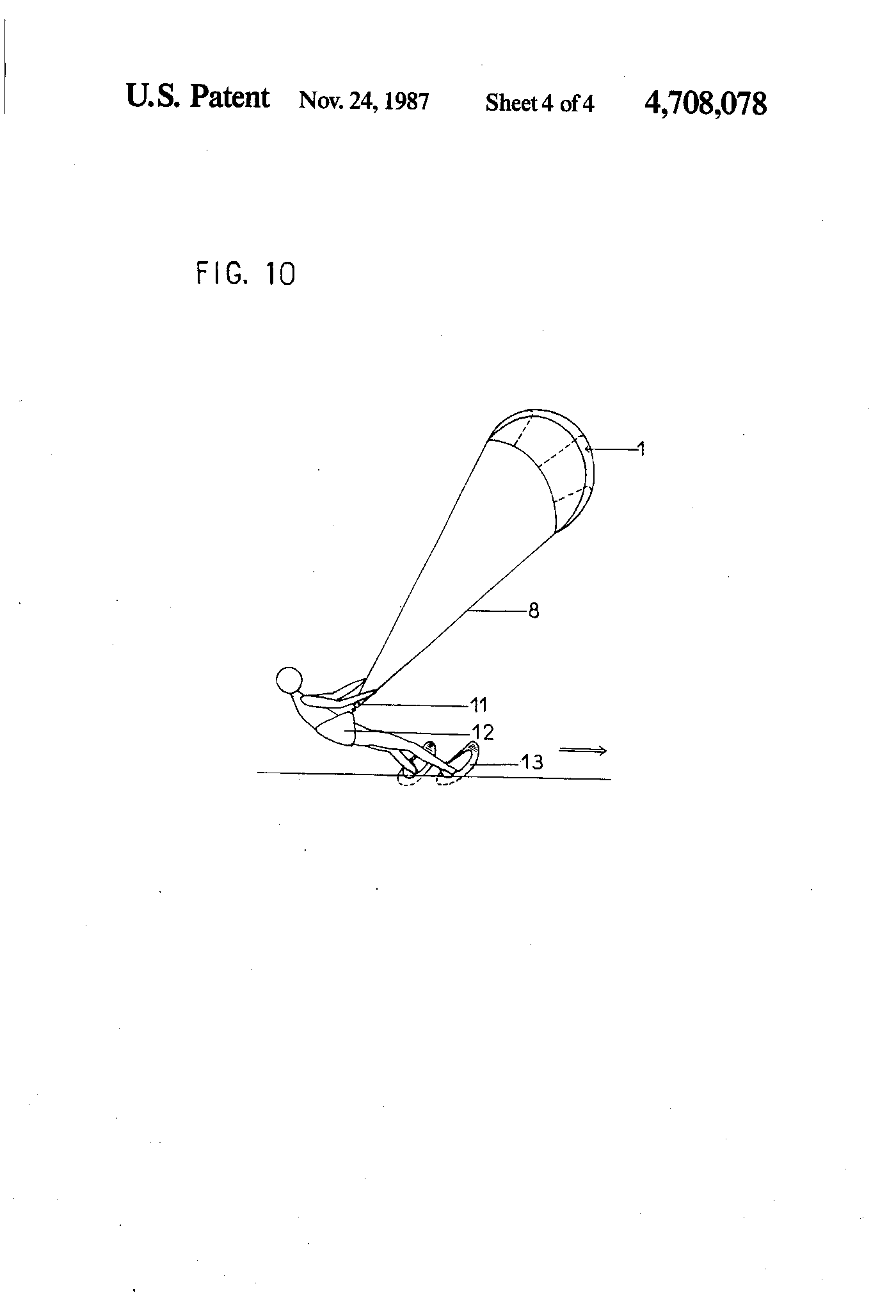
The patent did not only describe a kite. It described the kite pulling something, with a rope to each tip — the arrangement a modern bar still uses.
Drawing sheet from US Patent 4,708,078, "Propulsive wing with inflatable armature", B. T. and D. M. Legaignoux. United States Patent and Trademark Office. Public domain.Public domain (US government work)patents.google.comUS 4,708,078 — Propulsive wing with inflatable armature (D. and B. Legaignoux)IKSURFMAG — Who invented kitesurfing?
22 November 1994
The KiteSki is patented
William and Cory Roeseler's KiteSki published as US 5,366,182: a free-flying airfoil tethered to a water ski, steered from a control bar that also carries the tether reel. It was filed on 30 November 1993.
Why it mattered: The patent puts the pull at the ski's centre of lateral resistance, and argues that this is why a kite can carry more sail area than a fixed mast allows.
US 5,366,182 — Kiteski (W. G. Roeseler and C. Roeseler)IKSURFMAG — 100 Moments: A Kitesurfing Timeline (Issue 100)
Questions
Common questions
Who invented kitesurfing?+
No single person. The earliest patent for the arrangement is Gijsbertus Panhuise's, filed in April 1976 and published in October 1977, but nothing is known to have been built from it. The inflatable kite every modern kite descends from is Bruno and Dominique Legaignoux's, with a priority date of 16 November 1984. The first kite-and-board system actually sold was William and Cory Roeseler's KiteSki, patented as US 5,366,182.
When was kitesurfing invented?+
It depends which document you count. 1976 and 1977 are the filing and publication of the Panhuise patent. 1984 is the Legaignoux priority date. 1985 is their US filing and 1987 is when that patent published, which is why the same invention is dated to three different years by sources that are all quoting something real.
Is there a patent for kitesurfing?+
There are several, and they cover different things. NL 7603691 covers the board-and-kite arrangement. US 4,708,078 covers the inflatable wing and its two control ropes. US 5,366,182 covers a tethered airfoil pulling a water ski from the ski's centre of lateral resistance. No patent covers the sport itself.
Sources for this page
Every dated claim above traces to the sources listed with it. These are the publications this page is built on.